In this article
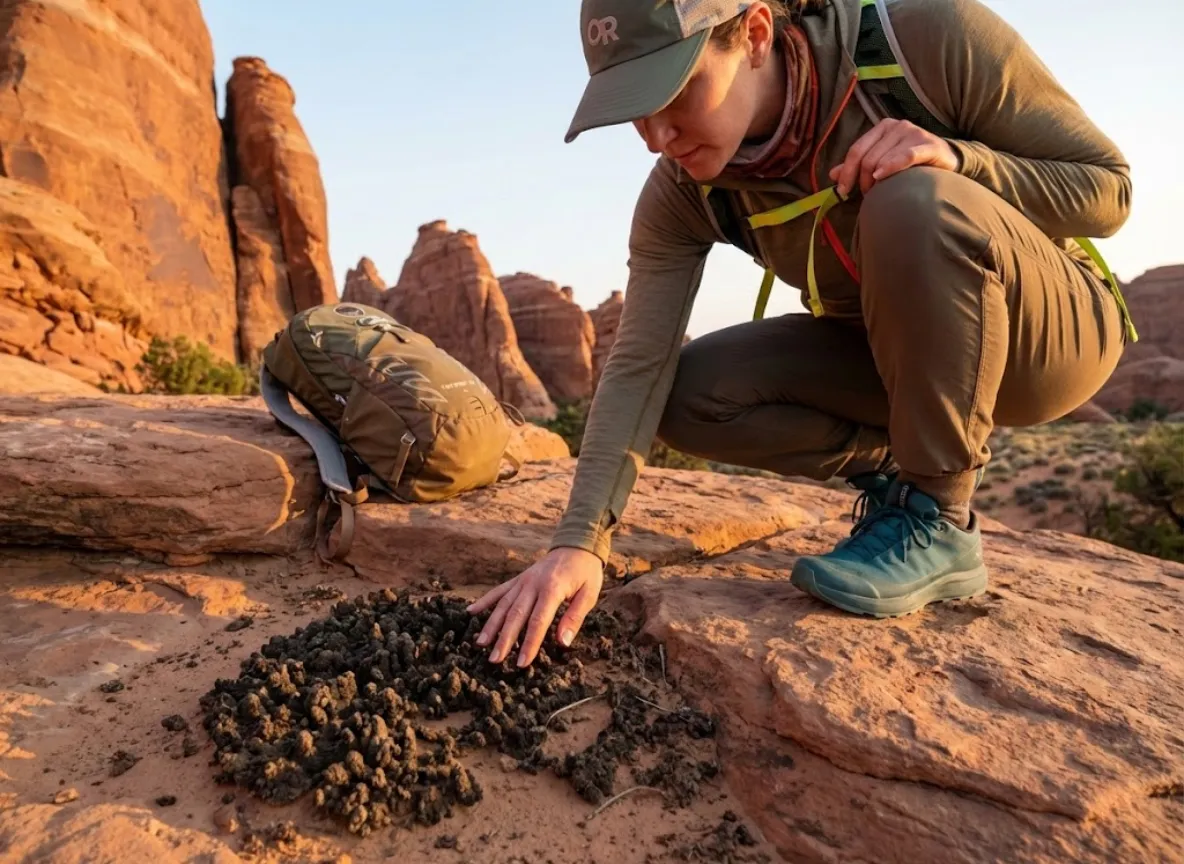
The crunch underfoot stopped me cold—a hollow, brittle sound like stepping on dry cereal. In the stillness of Canyonlands, that sound carried. I looked down at the black, knobby surface now fractured beneath my boot and felt a sinking realization: I’d just destroyed something that was already ancient when the first Spanish explorers crossed this plateau.
After fifteen years of hiking the Colorado Plateau, I’ve learned that what looks like simple dirt between the sandstone fins is actually a living biological crust—the fragile foundation holding the entire high desert ecosystem together. And I’ve made enough mistakes to know exactly what you need to avoid making those same errors.
Here’s how to identify cryptobiotic soil before you step on it, understand why it matters, and travel through the desert without leaving damage that will outlast your grandchildren.
⚡ Quick Answer: Cryptobiotic soil is a living crust of cyanobacteria, lichens, and mosses that stabilizes desert soil, fixes nitrogen, and retains water. It takes 50-250+ years to fully recover from a single footstep. Identify it by its knobby, black, pinnacled texture when dry (vibrant green when wet). Your only protection strategy is complete avoidance—stay on rock, sand, or established trails.
What Is Cryptobiotic Soil? The Living Skin of the Desert
The Microbes Holding the Desert Together
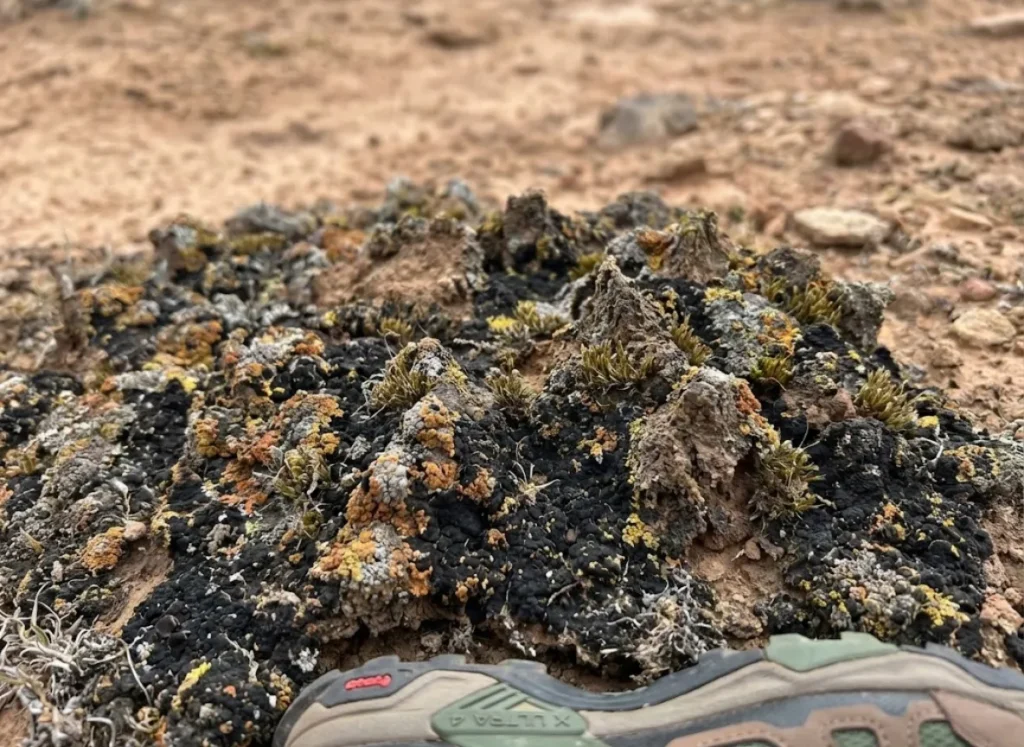
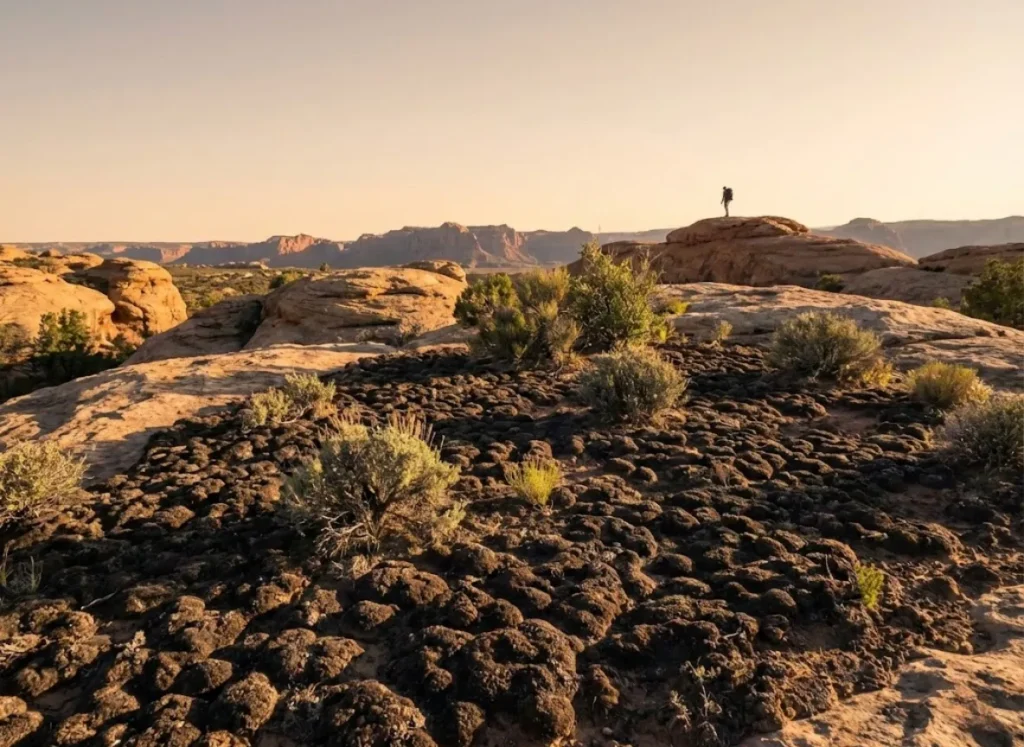
That dark, bumpy surface you see between rock fins isn’t burned dirt or a dried mud crust. It’s a biological soil crust—also called biocrust or cryptobiotic soil—and it’s alive.
The term comes from Greek: kryptos (hidden) and bios (life). During dry periods, these organisms appear completely dormant and dead. But they’re working even when you can’t see it.
The primary architect is a filamentous cyanobacterium called Microcoleus vaginatus. As it moves through the soil seeking moisture and sunlight, it leaves behind sticky polysaccharide sheaths—like microscopic trails of glue. Over decades, these abandoned sheaths accumulate into a three-dimensional net that physically binds loose soil particles together.
Pro tip: When you see soil that looks “burnt” or covered in a dark crust, you’re looking at decades—sometimes centuries—of microbial construction. That’s not dirt; that’s a biological city.
Lichens and Mosses: The Old-Growth Forest at Your Feet
Once the cyanobacteria matrix stabilizes the ground, secondary organisms move in. Soil lichens like Collema (jelly lichen) form black, gelatinous structures and are critical nitrogen fixers. Desert mosses like Syntrichia caninervis indicate crusts that have been undisturbed for generations—the “old growth” of the biocrust forest.
If you see green tufts or colorful patches (orange, yellow, black) on the desert floor, you’re standing near some of the most mature, vulnerable living soil on the planet.
Why “Desert Glue” Is the Most Accurate Nickname
This biological soil crust acts as nature’s glue. It stabilizes soil against 70+ mph desert winds that would otherwise strip the landscape bare.
Without this protective layer, the loose sand becomes fugitive dust. That heat-absorbing dust blows east, settles on Rocky Mountain snowpack, absorbs solar radiation, and accelerates spring snowmelt by three to six weeks. The downstream effects ripple through the entire Colorado River basin’s water supply timing—affecting millions of people.
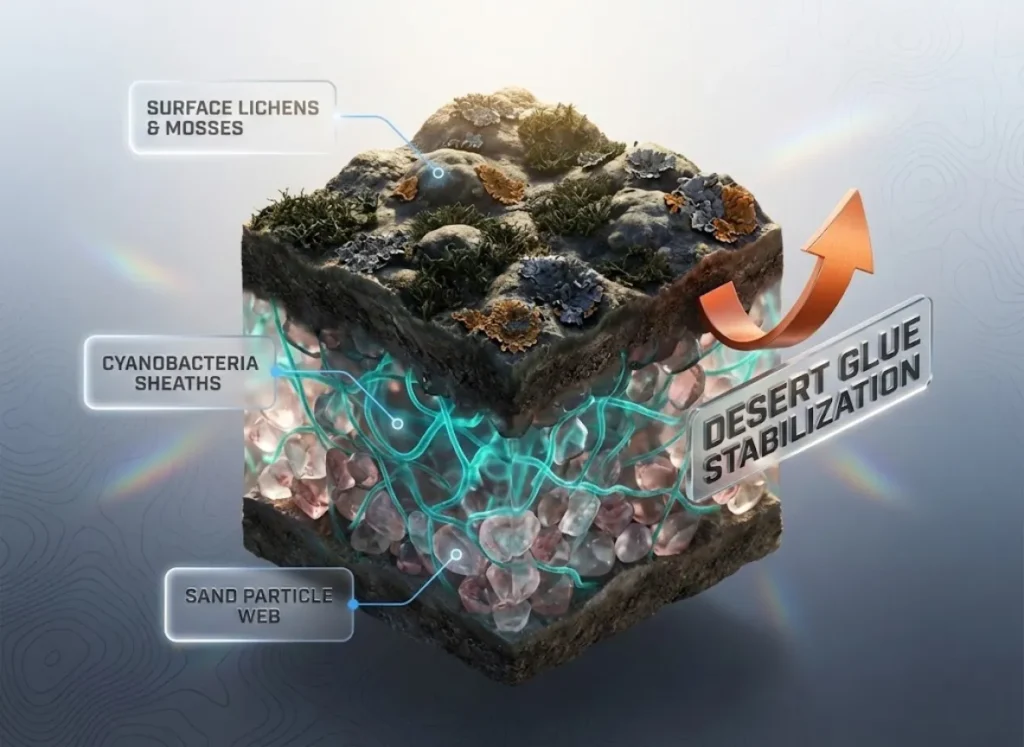
According to USGS biocrust research, biocrusts cover up to 70% of living soil surfaces in parts of the Colorado Plateau. When you’re walking through Arches or Canyonlands, you’re walking through a landscape that depends on this invisible foundation.
Understanding cryptobiotic soil connects directly to the broader principles of Leave No Trace that every serious desert hiker should master.
Field Identification: How to Spot Cryptobiotic Soil Before You Step On It
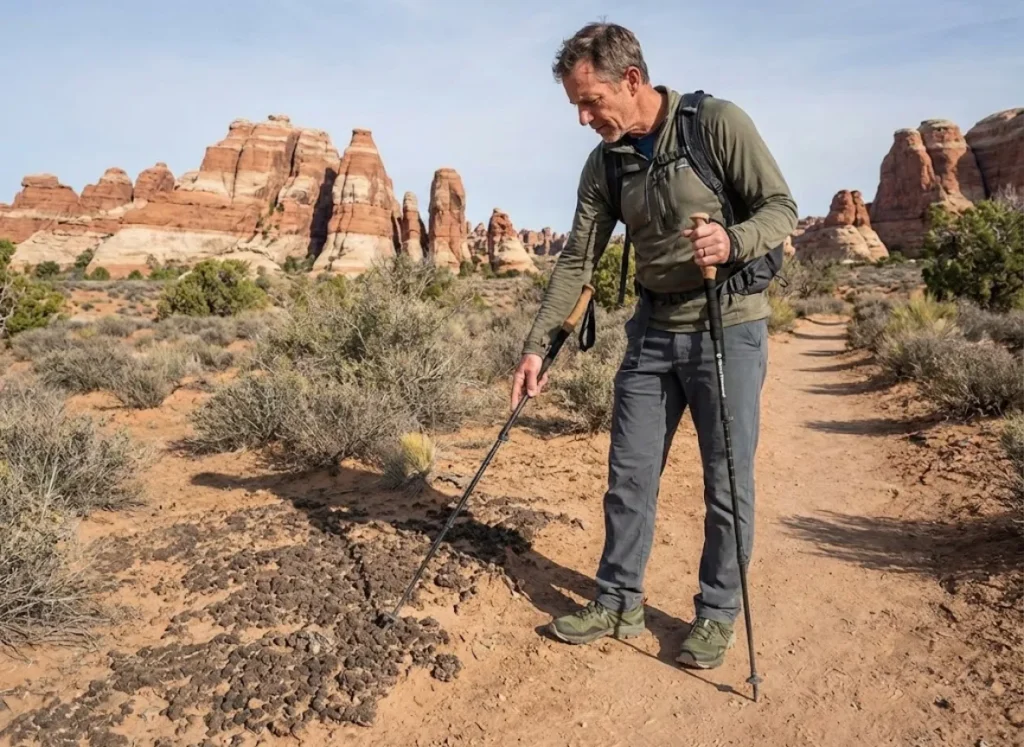
The Dry vs. Wet Transformation
Here’s what makes cryptobiotic soil identification tricky: the crust looks completely different depending on whether it’s wet or dry.
These organisms are poikilohydric—they equilibrate their internal water content with the environment. They can desiccate completely and remain dormant for months, then spring back to life within minutes of wetting.
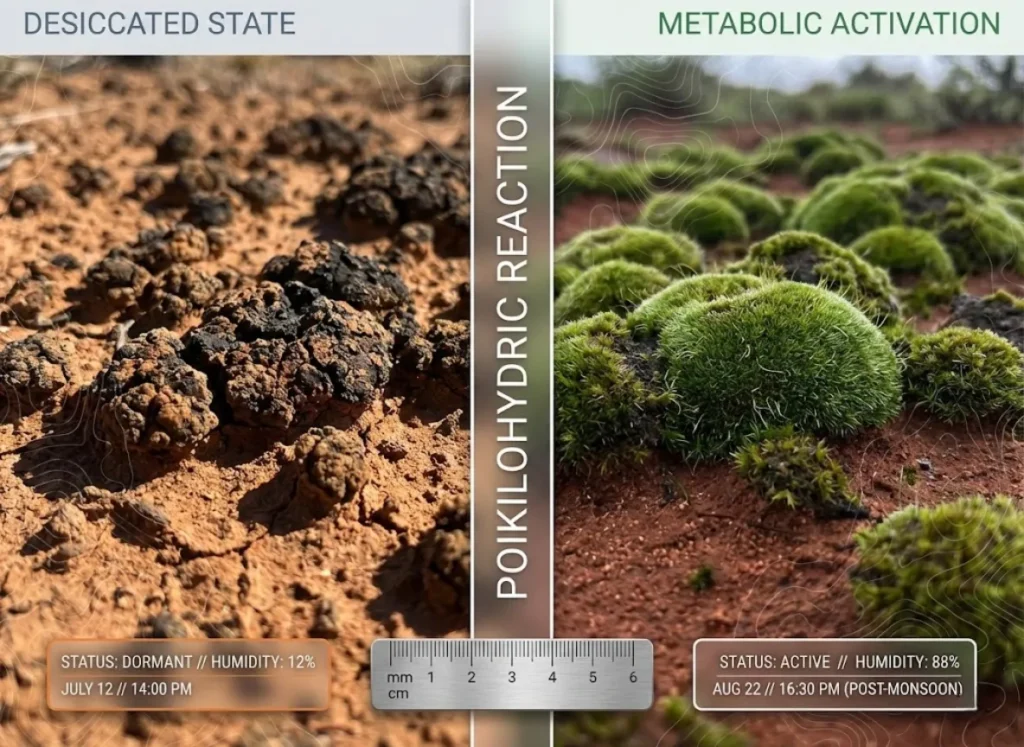
In dry conditions (how most visitors see it): The crust appears dark brown to black. The texture is brittle and crunchy. Pinnacles are rigid. This is actually when the crust is most vulnerable—the polysaccharide sheaths become brittle and snap under pressure.
In wet conditions (after monsoon rain): The crust transforms dramatically. It turns vibrant green as chlorophyll activates. The texture becomes soft and spongy. This “greening of the desert” is one of the few times these organisms reveal their true living nature.
Successional Stages: From Invisible to Pinnacled
Biocrusts develop over long periods, and their appearance changes as they mature.
Early succession crusts are the hardest to identify. The soil surface appears flat and brown, almost indistinguishable from bare earth. Here’s the test: poke it gently. If the sand grains are fused rather than loose, you’re standing on young crust. Don’t step there.
Late succession crusts are unmistakable in the Colorado Plateau. They form distinctive pinnacles or pedicels—soil towers up to 10 cm high—often covered in lichens and mosses. This frost-heaved structure develops over centuries as winter freezing pushes the crust upward while the sheath matrix holds it together.
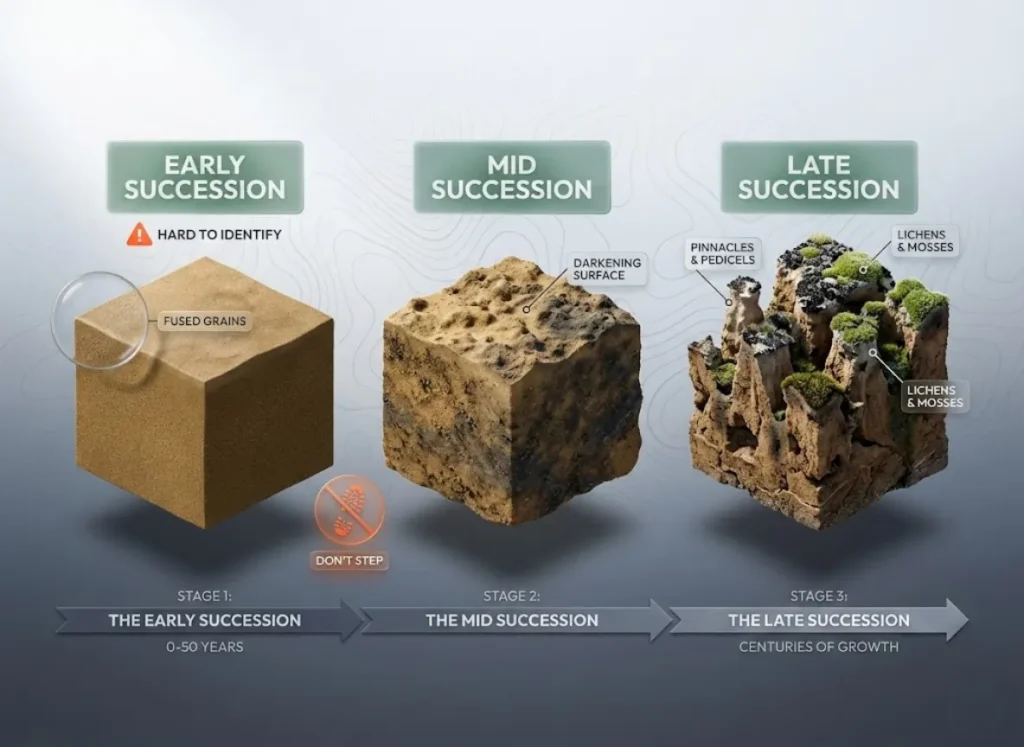
In hotter deserts like the Mojave or Sonoran, mature crusts remain flat. They’re harder to identify and easier to accidentally trample. When hiking Sedona’s red rock trails or Joshua Tree, expect less obvious visual cues.
Differentiating Look-Alikes: What ISN’T Cryptobiotic Soil
Not every crust is biological. Here’s how to spot the false cryptos.
Physical soil crust forms when raindrops compact bare soil. It’s smooth and platy, matches the parent soil color, and breaks cleanly like ceramic. No visible filaments inside. You’ll find it in disturbed areas along trails.
Dried mud appears in depressions where water pools. It forms curling “cornflake” flakes with deep cracks. No biological webbing inside.
Salt crust shows as white crystalline efflorescence in playa lowlands. It crumbles to powder when touched.
Pro tip: If you can examine a loose fragment without disturbing intact crust, look for hanging fibers holding sand together. Physical crusts break cleanly; biocrusts show that characteristic webbing from the polysaccharide sheaths.
Why It Matters: The Ecological Functions You’re Protecting
Nitrogen Fixation: The Desert’s Fertilizer Factory
Desert soils are notoriously nitrogen-deficient. The native plants around you—blackbrush, sagebrush, desert scrub—are all nitrogen-limited. They need fertilizer, and in the high desert ecosystem, biocrusts are the primary supplier.
Cyanobacteria like Nostoc and cyanolichens like Collema convert atmospheric nitrogen into plant-usable ammonium. Destroy the crust, and you effectively cut off the fertilizer supply for everything growing around it. The downstream effects cascade: stunted desert plants, reduced nutritional value in wildlife forage, and a weakening of the entire desert food web.
Erosion Control: What Happens When the Glue Fails
Those polysaccharide sheaths create soil aggregates larger and heavier than individual sand grains. This increases the threshold wind speed required to lift particles into the air. In plain terms: cryptobiotic soil prevents the desert from blowing away.
Here’s what happens when you break that protective crust: A single footprint depression acts as a wind tunnel. Wind turbulence scours the loose sand in the footprint, undercutting the edges of adjacent intact crust. The damage spreads beyond the original impact zone, creating “blowouts”—large destabilized areas that can bury nearby vegetation.
The dust-on-snow effect compounds the problem. Dark dust settling on Rocky Mountain snowpack absorbs solar radiation and accelerates melt by weeks—altering the hydrology of the entire Colorado River basin.
Water Retention: The Sponge the Desert Depends On
The rough micro-topography of pinnacled crusts creates millions of miniature dams. When rain falls, these structures trap water, increase residence time on the surface, and allow greater infiltration. Mosses and lichens absorb water like a sponge, slowly releasing it during dry periods.
Stand next to a mature biocrust patch after a monsoon rain. You can actually watch the water sitting there, soaking in slowly, rather than sheeting off into arroyos. That water absorption capability is what sustains desert vegetation through the long dry months.
How Damage Happens: The Physics of “Busting the Crust”
Compression, Shear, and Sheath Fracture
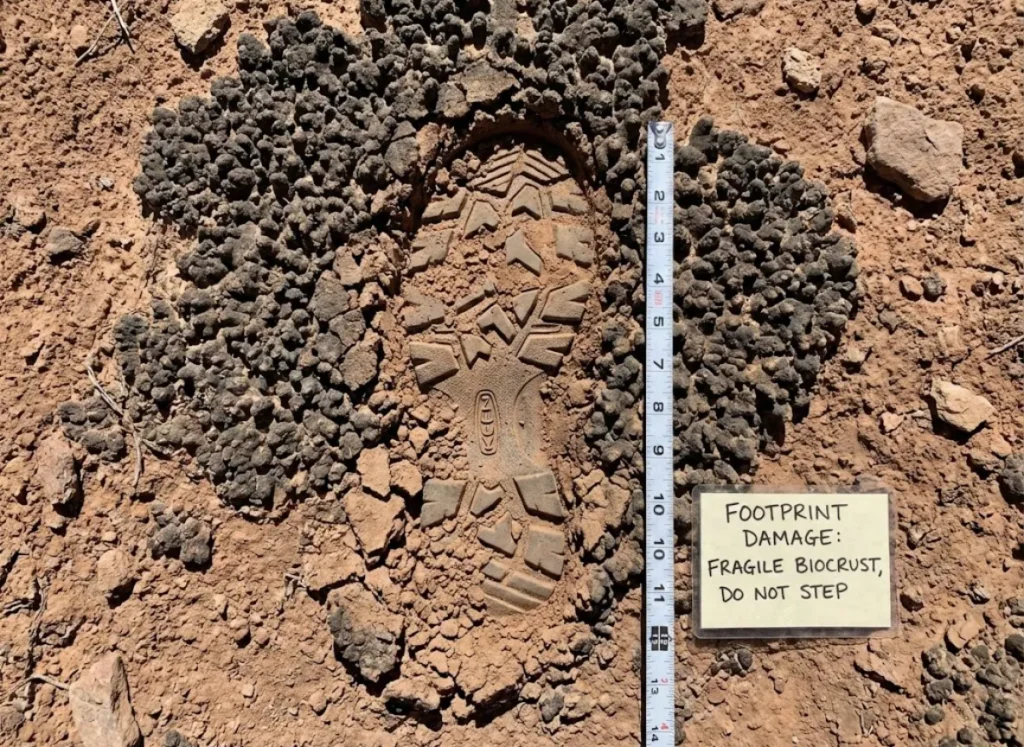
When your hiking boot lands on dry cryptobiotic crust, two forces go to work. Compression—your vertical weight—crushes the air pockets and flattens those century-old pinnacles. Shear—the horizontal force when you push off—snaps the brittle polysaccharide filaments beneath the surface.
Once that microscopic web is broken, the structural integrity is gone. The soil reverts to loose soil particles—unaggregated sand that wind and water will strip away.
Here’s the hard truth: there is no “safe” footwear. Hiking boots, trail runners, sandals—all exceed the yield strength of dry crust. Hiking boots vs trail runners is a false debate when it comes to biocrust impact. Both destroy it.
Dogs are actually worse because paw pressure is concentrated on a smaller surface area—higher pressure per contact point. That’s a key reason you see “no dogs” rules in places like the Needles District of Canyonlands National Park.
The Crunch You Never Want to Hear
Stepping on dry, mature biocrust produces a distinctive hollow “crunch”—widely compared to stepping on dry breakfast cereal. That sound is the audible shattering of the cyanobacterial matrix.
The “Don’t Bust the Crust” slogan originated in Moab, popularized by the NPS and local businesses as a cultural meme to signal ethical hiking. Listen for that crunch. If you hear it, you’ve already done damage—but what you do next matters.
Recovery Timelines: Decades to Centuries
Visual recovery can happen in 5-7 years under favorable conditions. A thin veneer of cyanobacteria may recolonize, restoring some soil stability. But that’s only the beginning.
Full functional recovery—the return of lichens and mosses that provide maximum nitrogen fixation and water retention—takes 50 to 250 years. In extremely arid zones like parts of the Mojave, or during extended drought, recovery may effectively never occur on human timescales.
According to Leave No Trace desert travel guidelines, the permanence of this damage is the core message every desert hiker needs to internalize.
Where You’ll Encounter It: High-Risk Trails and Regions
The Colorado Plateau: Global Epicenter for Pinnacled Crusts
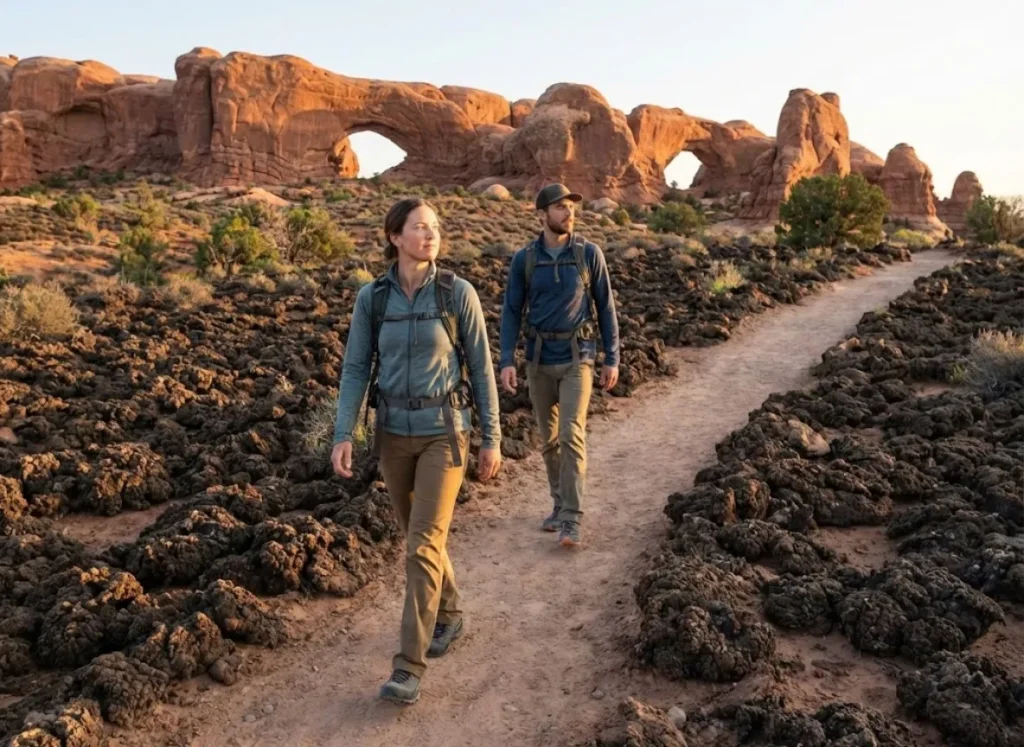
The Colorado Plateau—spanning Southeast Utah, Northern Arizona, Western Colorado, and Northwest New Mexico—is ground zero for the world’s most spectacular pinnacled biocrusts. The combination of sandy soils and cold winters creates the frost-heaving conditions that build those distinctive structures.
Devils Garden in Arches National Park is a high-risk zone. The Primitive Loop requires scrambling over sandstone fins, and hikers often step into crust-filled interspaces to let others pass. Trail braiding from this behavior is a documented problem.
Canyonlands Needles District contains some of the best-preserved biocrusts on Earth. Chesler Park and Joint Trail traverse meadows of mature crust. Stepping off the single-track trail for a photo usually means destroying centuries-old mosses.
Island in the Sky’s Syncline Loop explicitly warns of ubiquitous crust. Navigation requires strict adherence to cairns. When planning your visit, reference Zion’s desert trail network for similar guidance on the Chinle Trail’s biocrust zones.
Regional Variations: Mojave, Sonoran, and Great Basin
Not all biocrusts look alike. In the Mojave Desert (Joshua Tree, Death Valley), crusts are flatter and less visually distinct—dominated by cyanobacteria without the dramatic pinnacles. They’re harder to identify, making accidental trampling more common.
In the Sonoran Desert, crusts are often hidden beneath shrubs or invasive grasses like Buffelgrass. Fire from these invaders threatens the crusts that would otherwise act as firebreaks.
At Bell Rock in Sedona, social trail proliferation around vortex sites has created documented biocrust destruction zones. The wide-open terrain encourages hikers to walk side-by-side, causing trail widening even without malicious intent.
Best Practices: How to Travel Without Trace
The Durable Surface Hierarchy
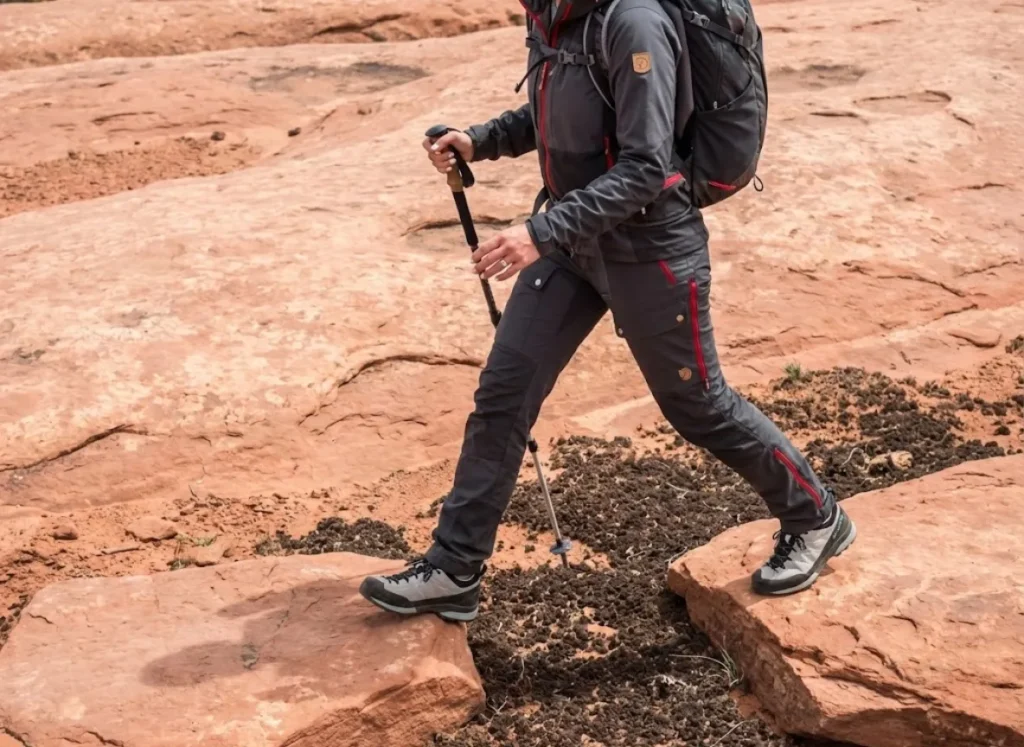
When navigating crust country on durable surfaces, memorize this order of preference.
First choice: designated trails. Even if muddy, stay on designated trails. “Skirting” the edge to avoid mud widens the trail and kills crust on both sides.
Second choice: slickrock. Sandstone is durable. If you lose the trail, move to the nearest rock surface to scout your route.
Third choice: sandy washes. Arroyos are frequently scoured by flash floods. They don’t support stable crusts and are safe for travel.
Fourth choice: loose sand or inorganic soil. Dunes and positively identified physical crusts are preferable to biocrust.
Emergency protocol: If you must cross a biocrust patch, walk single-file. One distinct path of disturbance is ecologically better than dispersed impact across a broad area.
Pro tip: “Stay on designated trails, step on rocks, walk in the wash, single-file through the crust—in that order.” Repeat this to your hiking partners until it becomes automatic.
Mastering the Leave No Trace principles makes this second nature.
Photography Ethics in Crust Country
The telephoto imperative: Use zoom lenses to capture features from the trail rather than walking up for a close shot.
Tripod placement: Those legs exert high pressure concentrated on small points. Always place them on rock or in the wash—never on the “bumpy dirt.”
Night photography: Astro shoots at dark-sky parks like Arches are popular, but scouting must happen in daylight. Black crust is indistinguishable from shadows at night. Pre-visualize your shot and mark safe standing zones during daylight hours.
What to Do When You Make a Mistake
If you hear that crunch, here’s the protocol.
Stop immediately. Don’t keep walking and compound the damage.
Retrace your exact steps. Don’t loop around—that creates more impact. Back out the way you came.
Do NOT attempt repair. You cannot “fix” the crust by pressing it back together. The biological filaments are broken. Covering it with sand only hides the damage and may impede natural recovery.

Learn from it. Use the moment to observe the broken structure. Look for the white filaments inside the clod. This reinforces your search image for the future.
I’ve made this mistake. Everyone who hikes the Southwest desert long enough eventually hears that crunch. What matters is what you do next—and that you never forget the sound.
Conclusion
Cryptobiotic soil is a living community of cyanobacteria, lichens, and mosses that acts as the desert’s actual foundation—stabilizing soil, fixing nitrogen, and retaining water. One footstep shatters centuries of growth. Full recovery takes 50-250+ years. There is no safe footwear; the only strategy is avoidance.
Learn the search image: knobby black crust when dry, vibrant green when wet, pinnacled structures in the Colorado Plateau, flat and subtle in the Mojave. Stay on designated trails, step on rock, walk in washes, and if you must cross crust, go single file.
The next time you stand at a trailhead in Arches National Park, Canyonlands, or Zion, look at that dark, bumpy soil between rock fins differently. It’s not dirt—it’s a microscopic forest centuries in the making. Don’t bust the crust. Leave it intact for the hikers who’ll walk these trails centuries after you’re gone.
FAQ
How long does cryptobiotic soil take to recover from a single footstep?
Full functional recovery takes 50 to 250+ years, depending on climate conditions. A thin cyanobacterial layer may return in 5-7 years, but the mature lichens and mosses that provide maximum nitrogen fixation and water retention require generations to re-establish.
Can I walk on cryptobiotic soil if I’m wearing soft shoes or trail runners?
No. All footwear types exceed the yield strength of dry biocrust. The damage comes from compression and shear force, not sole hardness. The only protection strategy is complete avoidance by staying on rock, sand, or established trails.
What does cryptobiotic soil look like when it’s wet?
Wet biocrust transforms to vibrant green as chlorophyll activates in the cyanobacteria. The texture becomes soft and spongy rather than brittle. This greening of the desert after rain is one of the few times these organisms reveal their living nature.
Why are dogs not allowed on some desert trails?
Dog paws exert higher pressure per square inch than human feet due to their smaller contact area. Additionally, dogs naturally wander, sniff, and dig—behaviors catastrophic to biocrusts. Rules prohibiting dogs are as much about soil protection as wildlife management.
Is cryptobiotic soil the same as dried mud or a salt crust?
No. Cryptobiotic soil is biological—knobby, black, often pinnacled. Dried mud forms curling flakes in depressions where water pools. Salt crusts are white crystalline efflorescence in lowlands. Biocrust fragments show hanging fibers holding sand together; physical crusts break cleanly.
Risk Disclaimer: Hiking, trekking, backpacking, and all related outdoor activities involve inherent
risks which may result in serious injury, illness, or death. The information provided on The Hiking Tribe is for
educational and informational purposes only. While we strive for accuracy, information on trails, gear, techniques,
and safety is not a substitute for your own best judgment and thorough preparation. Trail conditions, weather, and
other environmental factors change rapidly and may differ from what is described on this site. Always check with
official sources like park services for the most current alerts and conditions. Never undertake a hike beyond your
abilities and always be prepared for the unexpected. By using this website, you agree that you are solely
responsible for your own safety. Any reliance you place on our content is strictly at your own risk, and you assume
all liability for your actions and decisions in the outdoors. The Hiking Tribe and its authors will not be held
liable for any injury, damage, or loss sustained in connection with the use of the information herein.
Affiliate Disclosure: We are a participant in the Amazon Services LLC Associates Program, an
affiliate advertising program designed to provide a means for us to earn advertising fees by advertising and linking
to Amazon.com. As an Amazon Associate, we earn from qualifying purchases. We are also an official affiliate partner
of Black Diamond Equipment via the AvantLink network. If you click on a Black Diamond affiliate link and make a
purchase, we may earn a commission at no additional cost to you. We also participate in other affiliate programs and
may receive a commission on products purchased through our links. Additional terms are found in the terms of
service.