In this article
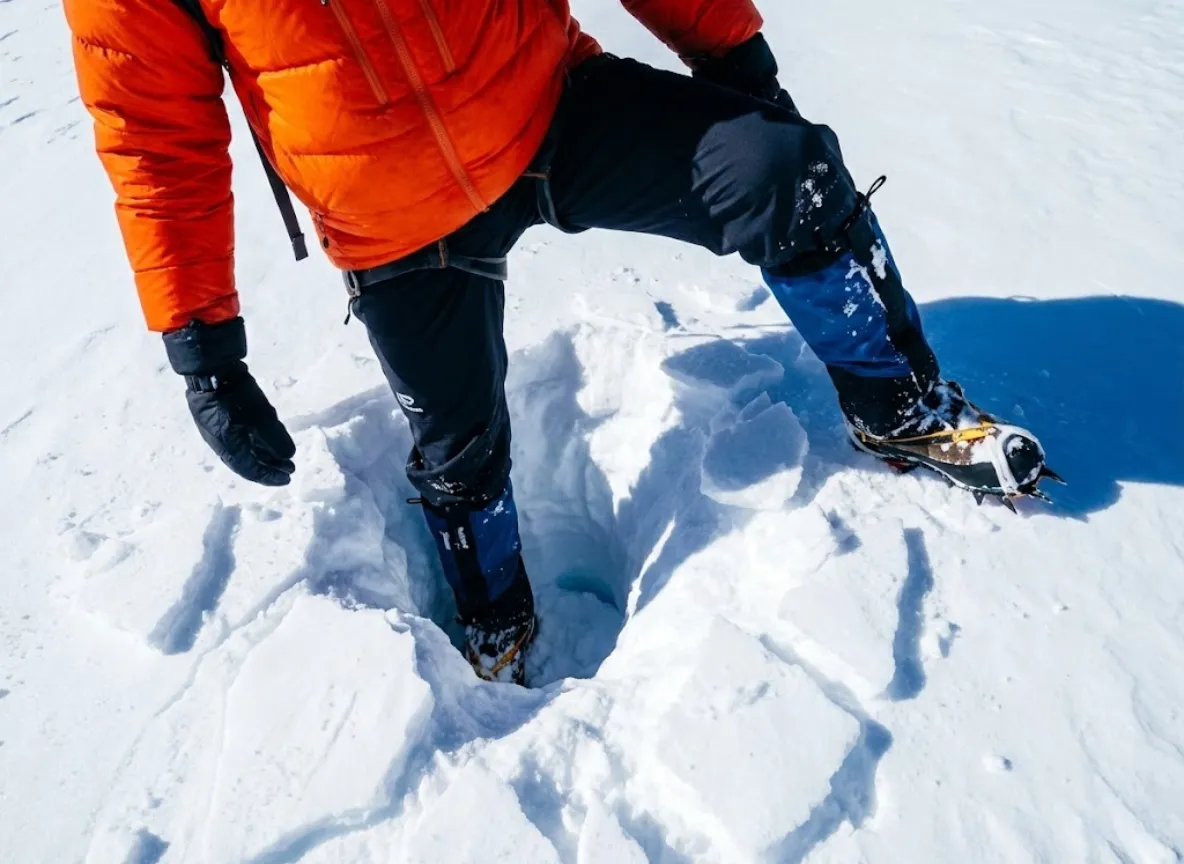
You step onto what looks like a solid white crust, and in a fraction of a second, the ground drops out beneath you. Your leg plunges into the void, the crust shatters, and your momentum drives your shinbone squarely into the hard, jagged edge of the ice. Your boot is now locked in a frozen vice three feet below the surface.
This isn’t just “sinking in snow” or a bit of “Type 2 fun.” This is a mechanical failure of the hiking environment known as postholing.
In my years leading groups through the Cascades and Rockies, I have seen seasoned athletes reduced to exhaustion and evacuations triggered by this single phenomenon. It transforms a simple outdoor endeavor into a socially contentious and injury-prone ordeal. True winter hiking safety isn’t just about fitness; it’s about understanding the physics of the snowpack and respecting the shared fragility of the trail.
This guide will move beyond the annoyance factor to explain the biomechanics of broken tibias, the specific protocols to prevent them, and how to extract yourself when the snowpack fails.
What Exactly is Postholing and Why Does It Happen?

Postholing is defined as the catastrophic failure of the snowpack’s structural integrity under a pedestrian’s vertical load. It creates a deep, cylindrical void similar to a hole dug for a fence post—hence the fence post analogy.
What are the Mechanics of the “Punch-Through”?
This phenomenon occurs when the pressure exerted by a boot—approximately 6 to 7 PSI—exceeds the compressive strength and shear resistance of the snow layers. The most common mechanism is the “punch-through.” Here, a hiker breaks through a consolidated surface crust (wind slab or melt-freeze crust) into weaker, unconsolidated layers beneath.
Understanding the phases of snow metamorphism and structural cohesion reveals why this happens. Beneath that deceptive surface crust, you often find “sugar snow” (faceted crystals) or “rotten snow.” These crystals have zero cohesion, offering no resistance until your boot strikes the ground or a denser layer deep below.
This dynamic load creates a “trap door” effect. The kinetic energy of your descent drives your leg deeper than your standing weight alone would. In spring, this failure is often driven by “isothermal” conditions, where the entire snowpack reaches 0°C. The snow loses its inter-granular bonding, turning into deep, wet slush—often called “mashed potatoes snow”—that provides no support. You can learn more about reading these environmental cues in our comprehensive winter hiking guide.
What Are the Physical and Medical Risks?
We need to stop viewing postholing as a nuisance and start viewing it as a medical and physiological hazard. The consequences range from metabolic collapse to severe orthopedic trauma like hyperextension or sprained ankles.
How Does the “Efficiency Tax” Deplete Reserves?
The “Efficiency Tax” (or speed penalty) refers to the geometric increase in metabolic cost required to travel through deep snow compared to firm ground. Military research utilizing the Pandolf equation suggests that sinking just 30% of your leg length increases energy expenditure during locomotion across snow by over 120%.
Postholing converts aerobic hiking into an anaerobic interval workout. Your burn rates can spike to 800-1,100 kcal/hr, rapidly depleting glycogen stores. Energy is lost to plastic deformation; the snow absorbs the energy of your step rather than returning it like a springy dirt track. This requires fresh kinetic energy for every single “lift and extraction” phase.
This “wallowing” motion forces you to lift your knee above your waist (high hip flexion) while maintaining lateral stabilization. These minor muscle groups fatigue quickly. This rapid metabolic drain leads to “bonking” (hypoglycemia) and significantly increases the risk of hypothermia as your body’s heat production crashes due to exhaustion. It is critical to calculate your exact hiking nutrition needs with this tax in mind to prevent total system failure.
Why is the Tibial Plateau Fracture the “Postholer’s Injury”?
The defining orthopedic hazard here is the Tibial Plateau fracture, caused by the “fixed foot” mechanism. When your boot is cemented in heavy, deep snow, it acts as an anchor. If you fall forward or twist, your femur grinds into the top of the tibia.
This mechanism does not require high speed. A tibial plateau fracture following low energy fall is common because the trapped leg generates immense torque. Lateral forces are particularly dangerous, causing valgus or varus stress that the knee hinge cannot accommodate. This often leads to broken legs or ACL ruptures.
Hidden hazards such as boulders, talus, or hidden creeks at the bottom of a posthole can cause direct impact trauma or severe lacerations upon the sudden drop. Extraction from this injury is exceptionally difficult. It often requires a litter carry-out in complex terrain, putting rescuers at risk. You should review field-tested wilderness first aid protocols to understand how to stabilize such an injury in the cold.
How Can You Prevent Postholing Through Gear and Strategy?
Prevention relies on two pillars: altering your physics with flotation and timing your travel to match the snow’s strength.
How Does Flotation Gear Change the Physics?
You must reduce your Ground Pressure (PSI) by increasing surface area. A standard boot exerts roughly 6.8 PSI. A 30-inch snowshoe can reduce this to approximately 0.96 PSI.
Snowshoes are your primary defense. Essential features for steep terrain include heel lifts (televators) to reduce calf strain and aggressive side-rails for traction on ice. AT Skis (Alpine Touring) or wide cross-country skis offer the best efficiency for travel on deep snow. Using skins provides necessary traction for the uphill.
Sizing is critical. A 22-inch snowshoe is insufficient for a 200lb hiker in fresh powder; your gear must be sized to your Total Load (body weight + pack weight). Be wary of the “Bare-Boot” fallacy—carrying snowshoes but refusing to wear them until you are already exhausted.
Also, note that traction devices like microspikes or crampons do not prevent postholing. They should only be used on fully consolidated trails or hardpack. Don’t forget gaiters to keep snow out of your boots, and trekking poles with wide snow baskets for balance. Research on the energy cost of walking in four types of snowshoes confirms that appropriate flotation is the only way to mitigate the metabolic tax. For help selecting the right tool, consult our data-backed guide on snowshoe sizing.
Pro-Tip: If you are bare-booting and sink past your ankle bone, stop immediately. Do not take another step without putting on snowshoes. If you don’t have them, turn around. This is the “Ankle Threshold.”
How Does Timing the “Melt-Freeze” Cycle Mitigate Risk?
In spring conditions, the snowpack follows a diurnal cycle: frozen and supportive at night, soft and unstable in the afternoon.
Your “Safe Window” for travel is early morning (often requiring 4 AM starts) to utilize the frozen crust for fast movement. The danger zone begins as solar radiation peaks. Once the crust warms to 0°C, it becomes isothermal and loses structural strength. Avalanche Canada provides excellent data on spring conditions and daily melt-freeze cycles, which is essential reading for timing your descent.
You must have a turnaround protocol. If you sink past your ankle three times in 100 yards, the surface is failing. Strategic retreat is necessary if you lack flotation. Continuing into warming snow guarantees deep, wet postholing and potential entrapment. Understanding the limits of microspikes vs. crampons will help you maximize that early morning frozen window safely. Checking SNOTEL data can also give you insight into snow density before you leave home.
How Does Postholing Impact Trails and Other Users?
Your decisions don’t just affect your safety; they can destroy the trail for everyone else. Whether you are in the White Mountains NH, the Adirondacks NY, or the Sierras CA, the etiquette remains the same.
What is the “Monorail” and Why Must It Be Preserved?
The “Monorail” is the narrow, packed strip of hard snow in the center of a popular trail. It remains distinct from the softer surrounding snow and is the only walkable surface.
Postholing fractures this structural beam. Holes created in the monorail allow warm air and water to penetrate, accelerating the disintegration of the entire path. Once the monorail is destroyed, the trail becomes impassable, forcing hikers into the deep, wet snow on the edges and widening the trail impact.
There is also a severe hiker vs skier conflict. Postholes that freeze overnight become “potholes” or “snares.” These can catch a ski tip on groomed trails, causing dangerous rotational falls for backcountry skiers. Hikers must also remember uptrack etiquette. You should never boot-pack directly in a ski track; it ruins the traction for skins, causing skiers to slip backward. We must share the snow.
Regions like the Adirondack High Peaks legally mandate snowshoe use when snow depth exceeds 8 inches to prevent this damage. Following these safety and outdoor ethics in winter ensures access remains open for everyone. This aligns with mastering outdoor ethics and Leave No Trace principles, which apply to snow surfaces as much as soil.
What is the Protocol for Self-Rescue and Entrapment?
Even with the best gear, entrapment happens. Knowing how to escape without injury is the final layer of safety.
How Do You Execute a Strategic Extraction?
1. Stop and Assess: The instinct to thrash or kick wildly must be suppressed. Panic accelerates your heart rate and causes you to sink deeper.
2. Unweight the System: Unclip pack hip belt and sternum strap. Prepare to ditch it if necessary. You need to spread weight.
3. The “Army Crawl”: Do not try to stand up vertically. Drop to your knees or stomach to maximize surface area. Roll to firm ground or crawl toward the edge of the trail.
Be hyper-aware of tree wells (or spruce traps in the Northeast)—the voids around the base of conifers. If you fall into one, fight to keep your head up and create an air pocket immediately, as Snow Immersion Suffocation (SIS) is a real risk. If you are inverted, do not push “up” against loose snow. Grab the tree trunk or branches to pull yourself upright.
If rescuing a partner, do not rush in, or you may collapse the snow onto them. Approach from the downhill side and dig a tunnel to their airway first. Review these tree well rescue best practices before venturing into deep powder. For a broader overview of getting unstuck, refer to our comprehensive hiker’s emergency guide.
Pro-Tip: Carrying a lightweight snow shovel (even on a day hike) isn’t just for avalanches. It is the single most effective tool for digging a trapped leg out of a frozen posthole without causing a fracture.
Final Thoughts
Postholing is a structural failure of the snowpack that spikes your metabolic cost by over 120% and creates severe orthopedic risks. It is not a rite of passage or a badge of honor; it is a warning sign. Flotation (snowshoes/skis) and timing (avoiding afternoon melt) are your only reliable prevention methods. Boots alone are simply insufficient physics for deep snow.
Respecting the “Monorail” and ski tracks is a critical component of trail stewardship. By understanding the mechanics of the snow and using the right tools, we keep ourselves safe and the trails usable for everyone.
Check the local avalanche center forecast and trail conditions before your next trip.
FAQ – Frequently Asked Questions
Is postholing dangerous or just annoying?
It is physically dangerous. Beyond exhaustion, it is a leading cause of Tibial Plateau fractures and ligament ruptures due to the fixed foot mechanism. It also poses environmental risks, such as entrapment in tree wells or hidden water crossings.
At what snow depth should I use snowshoes?
As a general rule, if you sink more than 6-8 inches (ankle-deep or hip-deep scenarios), you need flotation. Some regions, like the Adirondack High Peaks, legally mandate snowshoes at 8 inches of snow depth.
Can I use microspikes to prevent postholing?
No, microspikes provide traction on ice but offer zero flotation. Using them in deep, soft snow creates no benefit and can actually increase the risk of snagging or injury.
Why do skiers get mad at hikers for walking on the trail?
Hikers who posthole ruin the skin track or groomed surface that skiers rely on for traction. Frozen postholes act as dangerous obstacles that can cause skiers to crash or break equipment.
Risk Disclaimer: Hiking, trekking, backpacking, and all related outdoor activities involve inherent
risks which may result in serious injury, illness, or death. The information provided on The Hiking Tribe is for
educational and informational purposes only. While we strive for accuracy, information on trails, gear, techniques,
and safety is not a substitute for your own best judgment and thorough preparation. Trail conditions, weather, and
other environmental factors change rapidly and may differ from what is described on this site. Always check with
official sources like park services for the most current alerts and conditions. Never undertake a hike beyond your
abilities and always be prepared for the unexpected. By using this website, you agree that you are solely
responsible for your own safety. Any reliance you place on our content is strictly at your own risk, and you assume
all liability for your actions and decisions in the outdoors. The Hiking Tribe and its authors will not be held
liable for any injury, damage, or loss sustained in connection with the use of the information herein.
Affiliate Disclosure: We are a participant in the Amazon Services LLC Associates Program, an
affiliate advertising program designed to provide a means for us to earn advertising fees by advertising and linking
to Amazon.com. As an Amazon Associate, we earn from qualifying purchases. We are also an official affiliate partner
of Black Diamond Equipment via the AvantLink network. If you click on a Black Diamond affiliate link and make a
purchase, we may earn a commission at no additional cost to you. We also participate in other affiliate programs and
may receive a commission on products purchased through our links. Additional terms are found in the terms of
service.