In this article
Three miles into the John Muir Trail, my Darn Toughs smelled like they’d died inside my boots. By day five, the salt buildup felt like hiking with sandpaper wrapped around my heels. The blisters came fast, and I had 200 miles to go.
After spending fifteen years guiding backpacking trips through the Sierra, I’ve learned that proper sock care isn’t just about hygiene—it’s about preventing foot injuries that end trips early and protecting your $25-per-pair investment from premature destruction.
Here’s exactly how to preserve your technical Merino wool hiking socks through proper care, both at home and in the backcountry, to maximize blister prevention, warranty longevity, and the cost-per-wear economics of expensive technical gear.
⚡ Quick Answer: Turn wool socks inside-out before washing at 30°C (86°F) max using wool-specific detergent in a mesh bag. Never use fabric softener or tumble dry—both destroy moisture-wicking properties. For backcountry washing, use the oven bag method 200+ feet from water sources, dispose gray water in a cathole following Leave No Trace principles, and rotate three pairs including dedicated sleeping socks to prevent blisters from salt crystallization.
Why Merino Wool Socks Demand Different Care

Each Merino wool fiber consists of two distinct layers: a hydrophobic (water-repelling) exterior cuticle and a hydrophilic (water-loving) interior cortex. This dual structure allows the fiber to absorb up to 35% of its own weight in moisture vapor before the exterior feels damp to the touch. When moisture vapor gets absorbed, a natural chemical reaction releases small amounts of heat. During high-exertion hiking, the process reverses for evaporative cooling that maintains foot temperature an average of 4°F closer to optimal compared to synthetic alternatives.
The fiber’s natural crimp creates millions of miniature air pockets that provide thermal buffering. Merino fibers can bend 20,000+ times without breaking, giving them exceptional durability when cared for properly. The fine micron diameter (under 24 microns in quality hiking socks) eliminates the “itch” factor by bending on contact with skin rather than stabbing like coarse wool.
But here’s what most hikers don’t know: Merino’s antimicrobial properties slow bacterial growth—they don’t eliminate the need to wash. After multi-day trips, when salt crystallization becomes a friction hazard, washing becomes essential for blister prevention.
The Blister Equation: Why Clean Socks Matter
Blisters form through a simple relationship: Force × Distance × Time ÷ Sock Cleanliness Factor. Moisture plays a dual role. Very dry skin and very wet skin have lower friction, but damp or hydrated skin exhibits the highest “tack.” That sticky feeling increases shear force on your dermis.
Here’s where salt enters the story. When you sweat, moisture evaporates but salts remain. In synthetic socks, these salts form sharp microscopic crystals. During the mechanical action of hiking, these crystals act like 80-grit sandpaper, grinding against your skin and sock fibers. Merino wool mitigates this by pulling salt into the hydrophilic core along with moisture vapor, effectively “desalinating” your skin’s surface. But once the fiber reaches saturation, salts crystallize on the surface anyway—that’s when washing resets the fiber’s performance and prevents blisters.
Pro tip: If your socks feel crunchy after drying on trail, that’s salt crystallization. They need a full rinse cycle, not just air drying.
Warranty Preservation: The Hidden Economics
Darn Tough offers an “Unconditional Lifetime Guarantee” that covers inadvertent damage as long as the brand is identifiable. Their warranty policy remains valid regardless of washing method, though proper care extends lifespan. Smartwool provides a “100% Satisfaction Guarantee” typically capped at two years.
The cost-per-wear economics are straightforward: a $28 pair of Darn Toughs lasting five years with proper care works out to $5.60 per year versus $12 cotton socks replaced annually. But warranty claims require clean socks. If you’re shipping them back to Vermont covered in mud and sweat, you’re delaying your replacement.
Following a strategic gear investment approach means understanding that proper maintenance is part of the total cost equation.
Frontcountry Washing: Home Care Protocols
Machine washing risks shrinkage and felting if done incorrectly, but modern washing machines are safe for Merino wool when calibrated properly.
The Inside-Out Mandate
The highest concentration of skin cells, sweat salts, and bacteria lives on the interior sock surface. Turning socks inside-out ensures direct detergent access to these contaminants.
The secondary benefit is surface protection. When you invert the sock, you shield the exterior from the mechanical abrasion of the washing machine drum, significantly reducing pilling. Darn Tough, Smartwool, and Giesswein all mandate this step in their care instructions.
Machine Calibration: Temperature, Agitation, and Spin
Cold water or maximum 30°C (86°F) prevents fiber contraction and color bleeding. Hot water causes cuticle scales to lift and swell, leading to felting—a permanent interlocking of fibers that destroys breathability. Smartwool’s official washing guidelines emphasize this temperature threshold because once felting occurs, there’s no recovery.
Use the “Wool” or “Delicate cycle” with low agitation and higher water levels to cushion garments. Aggressive agitation causes fibers to lock together permanently. Set spin speed to maximum 800 RPM to reduce force that stretches elastic fibers and synthetic blends.
Always use a mesh laundry bag or lingerie bag to contain socks and reduce mechanical stress. This also prevents loss in the washer/dryer.
Load composition matters. Avoid washing wool socks with lint-producing fabrics like towels or blankets—lint embeds in wool’s crimped structure. Similarly, rough fabrics like denim accelerate fiber breakdown.
Detergent Chemistry: What Works (And What Destroys)
Merino wool is composed of keratin, a protein fiber highly susceptible to specific enzymatic environments. Many “heavy-duty” or “bio” detergents contain protease enzymes that target protein-based stains like blood or grass. The problem? The enzyme can’t distinguish between the stain and the wool fiber itself. This leads to gradual molecular disassembly—thinning, holes, and elasticity loss.
According to Woolmark Company’s detergent chemistry guidelines, wool thrives in a neutral to slightly acidic environment (pH 6-7). Standard powdered detergents are often highly alkaline, causing cuticle scales to lift and swell.
Both chlorine and oxygen bleach disassemble proteins. Oxygen bleach dissolves the tensile strength of wool fibers over time, causing brittleness. The recommended products list is short: Nikwax Wool Wash, Eucalan (no-rinse lanolin-enriched), and Wool ite pH-neutral liquid formulas.
The Fabric Softener Prohibition
Fabric softeners coat fibers in a thin layer of waxy lubricant. This coating plugs the pores of the Merino wool fiber, destroying its signature moisture management advantage—the ability to move moisture vapor from skin to exterior.
The lubrication also makes it easier for fibers to migrate to the surface, causing excessive pilling. Once applied, fabric softener residue is extremely difficult to remove.
I tested this with a pair of Darn Toughs after a single fabric softener wash. They felt clammy within two miles and developed surface pills by mile five. The socks went from four-season performers to yard work socks in one wash cycle.
Pro tip: If someone else in your household uses fabric softener, run an empty rinse cycle before washing your wool socks to flush residue from the machine.
Drying Without Destruction
High heat causes irreversible shrinkage through felting—cuticle scales lock together permanently under the combination of heat, moisture, and agitation. Synthetic fiber components (nylon, spandex) in technical socks have lower melting points than wool. Excessive heat degrades elastic properties and can cause localized melting.
Even “tumble dry low” settings risk cumulative damage. Those settings typically reach 55-65°C (130-150°F), well above wool’s safe threshold of 40°C (104°F). Radiators, direct sunlight, and campfires present the same risk.
Air Dry Flat: The Gold Standard
Lay socks flat on a clean, dry towel in a shaded, well-ventilated area. The flat position prevents gravity-induced stretching. While socks are still damp, gently pull them to original dimensions to counteract any slight shrinkage from washing.
Drying time varies: 12-24 hours in dry climates, 24-48 hours in humid environments. Use a fan to accelerate drying without introducing heat—active airflow reduces drying time by 30-40%.
The Hang Dry Compromise
Hanging is acceptable for Merino/synthetic blends with reinforced structure, like Darn Tough and Smartwool with nylon content over 15%. Clip socks at the cuff (not the toe) to distribute weight across the reinforced band. Avoid wire hangers that create pressure points.
Monitor for stretching. If your cuff band shows permanent elongation, switch to flat drying. Following proper gear storage environment protocols matters—ventilation, no direct heat, and humidity control are key.
Backcountry Washing: Trail-to-Home Care
On multi-day treks, maintaining hygiene without machine access requires understanding Leave No Trace principles and creative problem-solving.
Leave No Trace Compliance: The 200-Foot Rule
Travel a minimum 200 feet (approximately 75 adult paces) from any lake, stream, or spring to prevent riparian contamination. Gray water containing soap—even biodegradable soap—introduces phosphates and surfactants that disrupt aquatic ecosystems. The National Park Service Leave No Trace guidelines are clear: direct soap introduction to water sources is prohibited.
Use a cathole (6-8 inches deep) or designated disposal site for gray water. Soil microbes filter and break down soap compounds—this is why distance from water matters.
The Oven Bag Washing Method
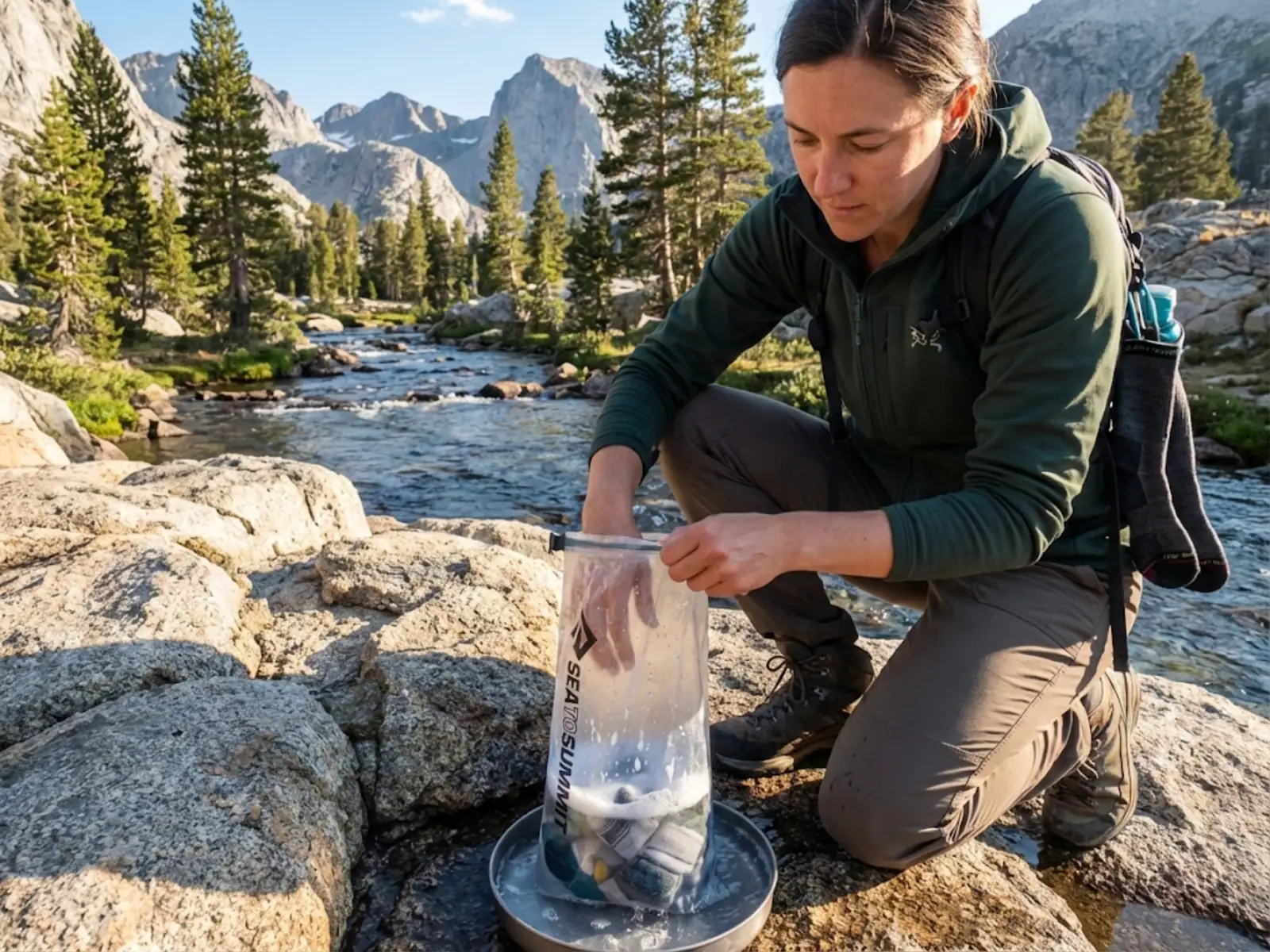
Use a lightweight oven-roasting bag or dedicated ultralight dry bag (8-10L capacity) as your portable washing machine. Fill the bag with 1-2 liters of water and 3-5 drops of Dr. Bronner’s (unscented or tea tree—avoid peppermint formulas which can irritate sensitive skin). Place inside-out socks in the bag, seal with air trapped inside to create an agitation cushion, and shake/knead for 10 minutes to loosen embedded salt, dirt, and skin cells.
Drain soapy water into your prepared cathole 200+ feet from the water source. Refill with fresh water and repeat agitation until rinse water runs clear—typically 2-3 rinse cycles.
Pro tip: The “Burrito Method” for extraction dramatically reduces drying time. Lay wet socks flat on your camp towel, roll the towel tightly, and stand on it. Pressure forces liquid water into the towel, leaving socks damp rather than soaked.
Trail Drying Logistics
Hang socks in direct sunlight when possible—UV rays kill remaining bacteria that washing may have missed. Attach damp socks to your backpack exterior using shock cord, carabiners, or safety pins. Airflow during hiking accelerates evaporation through passive airing.
For damp socks on cold nights, place them inside your sleeping bag near your thighs (not on your feet). Body heat drives off residual moisture overnight without introducing external heat that could damage fibers.
The Three-Pair Rotation System
Pair A (Active): Currently hiking. Pair B (Recovery): Drying and airing from yesterday’s wash. Pair C (Sacred Sleeping Socks): Kept in a waterproof bag, worn ONLY inside your sleeping bag to ensure feet spend eight hours nightly in a clean, dry environment.
This rotation allows skin to recover from maceration, prevents fungal infections, and extends sock lifespan by distributing mechanical wear. Three pairs of $25 Darn Toughs ($75 total) for a two-week trek beats daily washing of one pair with inadequate drying time that leads to trench foot risk.
Planning your resupply box logistics for gear rotation becomes crucial on thru-hikes where you’re calculating quantities for extended trips.
Common Mistakes and How to Fix Them
After watching hundreds of hikers destroy expensive socks through preventable errors, these patterns emerge consistently.
Mistake #1: Using Regular Detergent With Proteases
The mistake is grabbing Tide, Gain, or other mainstream detergents without checking ingredient lists. The damage manifests as gradual fiber breakdown—thin spots, holes, and elasticity loss after 5-10 washes.
Switch immediately to wool-specific or enzyme-free detergent. The damage is cumulative and irreversible, so early detection is critical. Check labels for “enzyme-containing,” “bio,” or “advanced stain removal”—these are red flags for protease content.
Mistake #2: Hot Water Washing “For Deep Cleaning”
The belief that hot water is necessary to kill bacteria and remove odors is deeply wrong for wool. Merino’s antimicrobial properties combined with proper agitation and detergent achieve cleanliness at 30°C. Hot water provides no additional hygiene benefit while causing cuticle scales to lift and interlock, leading to felting and permanent shrinkage.
If your socks have already shrunk, no recovery is possible. Felting is irreversible.
Mistake #3: Backcountry Washing Directly in Streams
Rinsing soapy socks directly in alpine streams or lakes for convenience violates Leave No Trace Principle #3 (Dispose of Waste Properly) and federal land regulations. Surfactants in biodegradable soap still harm aquatic insect larvae and disrupt biofilm formation on rocks.
According to U.S. Fish & Wildlife Leave No Trace protocols, the ecological consequences extend beyond the immediate wash site. Rangers increasingly issue fines in high-use areas like the John Muir Trail and PCT for visible soap use near water.
Always use the oven bag method 200+ feet from water sources. Collect rinse water in the bag and dispose in a cathole.
Mistake #4: Machine Drying on “Low Heat”
The assumption that “tumble dry low” settings are gentle enough for Merino blends causes consistent damage. Even low heat settings reach temperatures that degrade nylon/spandex reinforcement. Socks lose compression and fit after 3-5 dryer cycles.
Air dry only—no exceptions. Invest 10 minutes in flat-drying setup to protect your $25-$30 investment.
Darning and Repair: Extending Sock Lifespan
Darn Tough encourages darning small holes and explicitly states that professional darning does not void their lifetime warranty. Holes smaller than 5mm in diameter are ideal candidates—larger holes compromise structural integrity and are better suited for warranty replacement.
Address thinning areas BEFORE they become full holes to maintain knit structure. The warranty claim process requires submitting clean socks to their Vermont mill via online form; a credit code is issued for replacement pairs.
The Backcountry Emergency Darn
Materials: dental floss or thread from your repair kit, needle (or improvised with a safety pin). Create a simple cross-hatch pattern over the hole to prevent spreading. Turn the sock inside-out for darning to ensure a smooth interior surface against skin—rough repair seams cause new blisters.
Permanent Home Darning
Use wool-nylon blend thread to ensure the darned section has similar moisture-wicking and thermal properties as the original sock. Weave a “web” over the hole rather than pulling edges together—this prevents thick seams that create pressure points.
Insert a darning mushroom or smooth stone into the sock to create a firm backing surface during repair. Professional darning services cost $8-$15, but DIY darning preserves a $25 sock for 6-12 additional months of use.
Conclusion
Here’s what preserves your Merino wool investment and keeps your feet blister-free on trail:
Home washing: Cold water (30°C max), inside-out, wool-specific detergent, mesh bag, no fabric softener—ever. Air dry flat for 24 hours.
Backcountry washing: Oven bag method 200+ feet from water, three-pair rotation with sacred sleeping socks, burrito extraction technique for faster drying.
Avoid destruction: No proteases, no hot water, no tumble dry, no stream washing. These mistakes are irreversible.
Try the three-pair rotation on your next multi-day trek. Your feet—and your $75 investment—will thank you at mile 100.
FAQ
Can I machine dry Darn Tough socks on low heat?
No. Even low heat dryer settings reach 55-65°C (130-150°F), well above wool’s safe threshold of 40°C (104°F). Tumble drying causes irreversible shrinkage through felting and degrades nylon or spandex reinforcement. Air dry flat for 12-24 hours instead.
How often should I wash Merino wool hiking socks?
After 3-5 wears for day hikes; daily for multi-day backpacking trips where salt buildup creates friction hazards. Merino’s antimicrobial properties slow odor, but they don’t prevent salt crystallization that causes blisters and accelerates fiber wear.
Does washing wool socks void the Darn Tough warranty?
No. Darn Tough’s Unconditional Lifetime Guarantee remains valid regardless of washing method. However, socks must be clean when submitting warranty claims. Proper washing extends sock lifespan, reducing the need for warranty replacements.
Can I wash wool socks with regular clothes?
Avoid washing with lint-producing fabrics (towels, blankets) or rough fabrics (denim). Lint embeds in Merino’s crimped fiber structure, and abrasive materials accelerate fiber breakdown. Wash with similar delicate items or dedicate a wool-only laundry load.
What’s the best soap for backcountry sock washing?
Dr. Bronner’s unscented or tea tree (3-5 drops per liter), or Campsuds. Avoid peppermint-scented soaps which can irritate sensitive skin. Always use the oven bag method 200+ feet from water sources and dispose of gray water in a cathole to comply with Leave No Trace principles.
Risk Disclaimer: Hiking, trekking, backpacking, and all related outdoor activities involve inherent risks which may result in serious injury, illness, or death. The information provided on The Hiking Tribe is for educational and informational purposes only. While we strive for accuracy, information on trails, gear, techniques, and safety is not a substitute for your own best judgment and thorough preparation. Trail conditions, weather, and other environmental factors change rapidly and may differ from what is described on this site. Always check with official sources like park services for the most current alerts and conditions. Never undertake a hike beyond your abilities and always be prepared for the unexpected. By using this website, you agree that you are solely responsible for your own safety. Any reliance you place on our content is strictly at your own risk, and you assume all liability for your actions and decisions in the outdoors. The Hiking Tribe and its authors will not be held liable for any injury, damage, or loss sustained in connection with the use of the information herein.
Affiliate Disclosure: We are a participant in the Amazon Services LLC Associates Program, an affiliate advertising program designed to provide a means for us to earn advertising fees by advertising and linking to Amazon.com. As an Amazon Associate, we earn from qualifying purchases. We also participate in other affiliate programs and may receive a commission on products purchased through our links, at no extra cost to you. Additional terms are found in the terms of service.