In this article
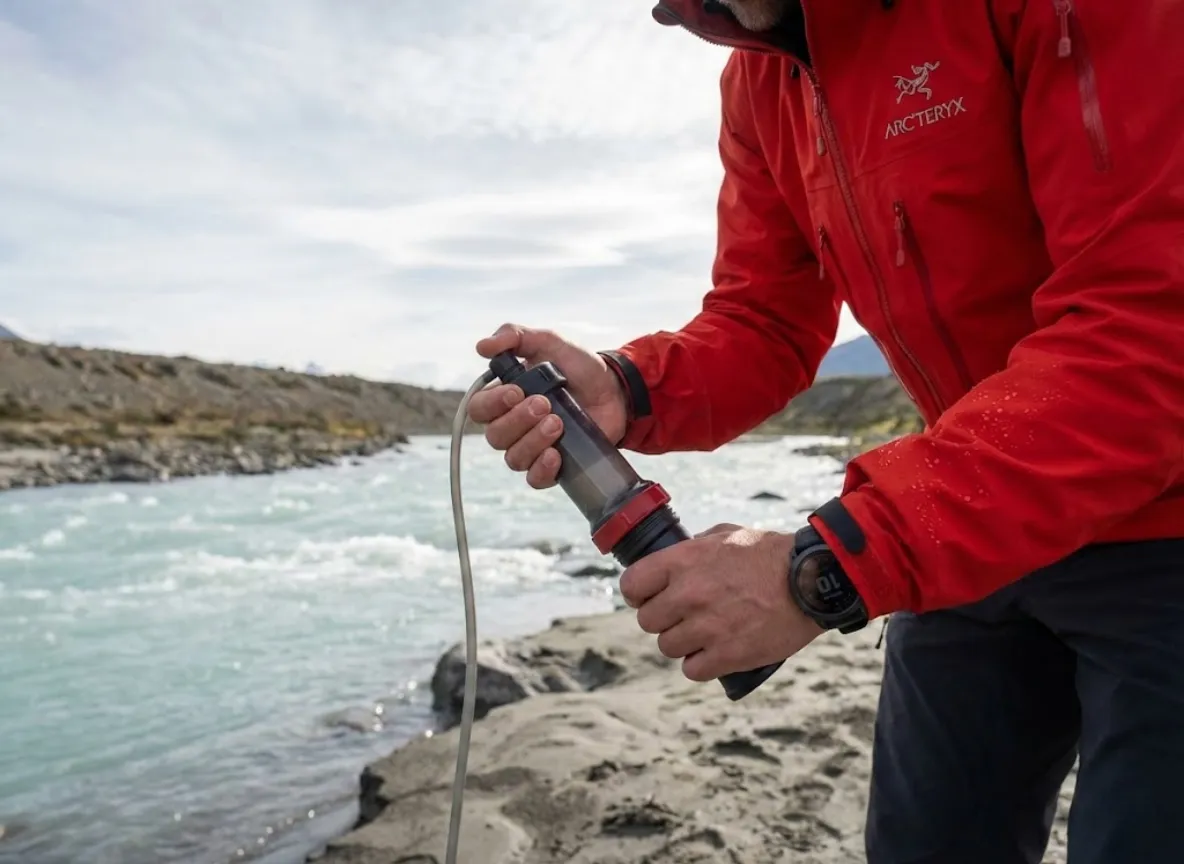
The resistance in the pump handle stiffens halfway through the second liter. You squeeze harder, and the ceramic element groans audibly before the flow rate reduces to a pathetic trickle. This isn’t just an annoyance; it is the complete failure of your water security system in the field.
I have seen this scenario play out countless times on extended expeditions, from the Escalante Route to the Croatan NF. A hiker treats their $300 MSR Guardian with care at home, only to break it in ten minutes by forcing it to drink from a glacial stream. Standard water filters are designed to stop bacteria, not liquid sandpaper.
To protect your gear from the abrasive destruction of glacial flour, desert silt, and river sediment, you must stop treating pre-filtration as an optional chore. You need to start viewing it as a mandatory shield for equipment longevity.
In this technical long-form guide, we will look at why your filter clogging occurs, the bio-diesel filter bags that actually work, and the chemical flocculation tricks necessary for muddy water that looks like chocolate milk.
Why Do High-End Filters Fail in Silty Water?

High-end filters, whether it’s an MSR MiniWorks EX or a Katadyn BeFree, fail in silty water because suspended sediment particles are often roughly the same size as the filter pores. This creates an impermeable seal called a “filter cake” on the element’s surface. Even worse, it can permanently scratch the internal cartridges of the pump. To solve this, we must look at the difference between swamp tannins that settle and the abrasive microscopic shards that do not.
How Does Sediment Particle Size Affect Filtration Mechanics?
Silt and clay are not identical. They are different categories based on silt particle size. According to USGS data regarding sediment classification, silt is small, but clay particles are significantly smaller—often invisible to the naked eye.
Standard hollow-fiber units like the Sawyer Squeeze or Platypus QuickDraw operate with tiny holes sized at a 0.1 micron rating. When you introduce river water full of silt, particles that are slightly larger than those holes stack up on the outside. This creates a dense layer of mud that acts like a wall, instantly blocking flow.
Water Sediment & Filtration Guide
Comparison of sediment types, particle sizes, and required filtration methods
Settling Time
Immediate to Minutes. Large particles drop out of suspension quickly due to weight.
Recommended Filter
Intake Screen, Gravity, or Woven Fabric (Bandana). Coarse filtration is sufficient.
Settling Time
Slow (Hours). Requires significant standing time to clear without mechanical help.
Recommended Filter
Depth Filtration (Felt Bag). Needs a thicker medium to trap smaller particles.
Settling Time
Non-Settling (Colloidal). Particles are so small they remain suspended indefinitely.
Recommended Filter
Flocculation (Alum). Requires chemical agents to clump particles together for removal.
Settling Time
Variable; often colloidal. Extremely fine rock dust that colors water milky or turquoise.
Recommended Filter
Flocculation + Depth Filter. A multi-stage approach is required to protect standard filters from clogging.
The threat goes deeper than just a clog. Glacial flour consists of jagged silica shards. These particles act like sandpaper on your pump’s O-rings and pistons—common filter failure points. Unlike organic surface water mud which is soft, silica is abrasive. It can permanently scratch the inside of pump bodies, ruining the seal and rendering the unit dead-on-trail.
Understanding how these particles float helps us see why gravity works for sand in seconds but fails for colloidal silt, which can take days to settle. You have to take active steps to fix this turbidity, especially when considering debunking the 0.1 micron myth regarding pathogen protection. If cleaner water can’t get through the mud, neither can you.
What Are the Best Mechanical Pre-Filtration Methods?
If you are currently using a coffee filter, pantyhose, or bandanas, you are essentially trying to catch mosquitoes with a chain-link fence. To escape the limitations of thin mesh straining, we must look to industrial tools for a solution based on “depth.”
Why Is Surface Filtration Insufficient for Fine Silt?
Surface filtration fails because it works like a flat screen. Once the surface area is covered by a single layer of mud, the water flow stops completely.
Woven fabrics usually have gaps ranging from 100 to 300 microns—roughly a 40-micron screen on the low end. While this removes pine needles and dead bugs, it allows virtually all grit to pass through. You are left with water that looks cleaner but still contains the microscopic opacity that destroys your primary filtration system.
Coffee filters are tighter, but they are too small and weak. This leads to the “Backflush Loop.” You are forced into an endless cycle of pumping half a liter and needing backflush capability immediately to clear the clog. It is exhausting and inefficient.
True water protection requires “Depth Filtration.” This is where particles are trapped inside a thick maze of fibers, not just on the surface. Understanding the principles of sediment filtration helps us see why we need a thicker, non-woven barrier. This is a crucial step in choosing the right water filter or purifier system for wilderness survival.
How Do Industrial Felt Bags Revolutionize Backcountry Filtering?
The brown filter bag, often known as a “Biodiesel Bag,” is a felt filter originally designed for factories, not hiking. Unlike a woven fabric, felt is a chaotic mat of fibers. These bags use depth filtration, trapping particles throughout the thickness of the material. This creates a massive capacity for holding dirt, acting as a robust sediment water filter.
For hikers, a 1-micron filter bag creates a barrier tight enough to stop 99% of silt. It effectively removes a lot of the biological danger too, as confirmed by effectiveness of filtration on pathogens data. Many parasitic cysts are larger than 1 micron and get caught in the felt (though you still need to purify the treated water afterward).
Pro-Tip: Buy a “Size #1” (7×16 inch) polyester felt bag online for a few dollars. Cut off the heavy steel ring and sew a simple channel for a paracord drawstring. You now have a <2oz gravity pre-filter that outperforms $50 branded units.
The result is a gravity-fed setup, potentially hung as a tripod filter, that delivers visually clear water to your intake hose. This extends the primary filter’s life by magnitudes—a massive win for capital preservation—and significantly reduces the maintenance required for your Sawyer Squeeze or other hollow-fiber elements.
When Should You Use Chemical Flocculation?
Sometimes, mechanical filtration fails. When the water looks like pea soup water due to clay (like the Colorado River in the Grand Canyon), even a 1-micron bag cannot stop the particles. They are too small and they repel each other. This is when we turn to flocculants.
How Does Alum Clear Glacial Flour and Colloidal Clay?
Alum (Aluminum Sulfate) clears water by removing the electrical charge that keeps particles floating. This allows them to clump together via sedimentation.
Clay and glacial flour particles carry a negative electrical charge. Think of them like magnets with the same polarity; they push away from each other and refuse to settle. Aluminum Sulfate introduces positive charges that cancel this out.
Once the charge is gone, the sticky forces in nature allow the particles to clump together into “flocs.” These clumps become heavy enough to sink to the bottom of your bucket or Platypus reservoirs.
This is not standard filtration; it is “coagulation,” a miniature version of municipal water treatment. It separates the water into two layers: clear water on top and heavy sludge on the bottom. According to National Park Service guidelines for the Grand Canyon, this method is mandatory for water sources like the Colorado River. It is a vital skill for identifying reliable water sources in the wild when clear streams aren’t an option.
What Is the Safe Protocol for Field Application of Alum?
- Dosage: Use a pinch of alum—approximately 1/5 teaspoon (roughly 1 gram)—per gallon of water.
- Rapid Mix: Stir the water vigorously for less than a minute or two immediately after adding the powder. This spreads the chemical before it starts working.
- Wait Time: Allow the water to settle and treat. Warm water usually clears in 20-30 minutes, while cold glacial water may take over an hour.
Once the sediment settles, carefully pour off the top 80% of potable water through your mechanical pre-filter. Throw away the sludge at the bottom.
Regarding safety, Alum sinks to the bottom with the mud. The public health statement on aluminum generally confirms safety for short-term backcountry use when applied correctly.
Pro-Tip: Alum works best in warmer water. If you are treating near-freezing glacial runoff, fill your “dirty water” bag and let it sit in the sun or against your body (if in a bottle) to warm slightly before adding the chemical. This speeds up the reaction significantly.
Remember, this process clears the water but does not kill viruses. You must understand the difference between water filters and purifiers—perhaps adding a SteriPen or chemical drops step—to ensure you are fully protected after the opacity is removed.
How Do You Execute an Integrated Turbidity Workflow?
We have the tools; now we need a silt-to-filter decision matrix. You need to know which method to use the moment you arrive at the water source to ensure field-maintainability.
How Can You Test Water Cloudiness Without Equipment?
You can test the turbidity levels using the “Knuckle Test,” a simple rule of thumb used by field scientists as a substitute for checkerboard opacity gauges.
Submerge your finger into a Nalgene or cup of the source water.
- Case A: If you can see your second knuckle clearly, the water is likely treatable with just the Felt Bag.
- Case B: If your knuckle disappears or looks blurry, the water contains colloidal silt. You must use the Alum Protocol.
This simple check aligns with the principles of constructing a turbidity tube for field science.
For the worst “chocolate milk” water, use a hybrid approach. Let the Alum settle the mud first, then pour the clear water through the felt bag to catch any stray clumps. This ensures your downstream filters see nothing but clear water.
Logistics matter here. Always carry a “Dirty Water” vessel (like a 1-gallon HDPE container or collapsible bucket) separate from your “Clean Water” storage. This prevents cross-contamination and allows space for the settling process. This setup should be a standard part of building your DIY hiker’s emergency kit.
Conclusion
The difference between a failed pump and a hydrated team often comes down to backpacking hydrology preparation. Here is your summary of operations:
- Diagnose: Use the “Knuckle Test” to decide between the felt bag and the chemical treatment.
- Mechanize: Replace ineffective bandanas with 1-micron filter bag solutions for superior sediment filters.
- Chemicals: Use Alum to clump clay together before it ever touches your pump.
- Preserve: Pre-filtration is not an option; it is the only way to ensure your gear lifespan extension in the wild.
Before your next trip, get a Size #1 felt bag and a small vial of Alum. These are small additions to your kit that guarantee your water supply remains secure.
FAQ – Frequently Asked Questions about Pre-Filtering Silty Water
Does Alum make water safe to drink without filtering?
No. Alum only removes sediment (cloudiness). You must still filter or purify the clear water to remove pathogens like bacteria and viruses.
Can I use a coffee filter as a pre-filter?
It is not recommended. Coffee filters clog almost instantly with silt and tear easily when wet. They are frustrating and inefficient compared to felt bags.
What is a Millbank bag and where do I get one?
A Millbank bag is a tightly woven canvas filter historically used by the British Army. While effective, they are heavy, slow, and hard to find. Modern bio-diesel filter bags are a better, cheaper alternative.
How do I clean a felt pre-filter bag in the field?
Turn the bag inside out and rinse it vigorously in the dirty water source to wash away the trapped mud. Allow it to dry in the sun to prevent mold growth between uses.
Risk Disclaimer: Hiking, trekking, backpacking, and all related outdoor activities involve inherent risks which may result in serious injury, illness, or death. The information provided on The Hiking Tribe is for educational and informational purposes only. While we strive for accuracy, information on trails, gear, techniques, and safety is not a substitute for your own best judgment and thorough preparation. Trail conditions, weather, and other environmental factors change rapidly and may differ from what is described on this site. Always check with official sources like park services for the most current alerts and conditions. Never undertake a hike beyond your abilities and always be prepared for the unexpected. By using this website, you agree that you are solely responsible for your own safety. Any reliance you place on our content is strictly at your own risk, and you assume all liability for your actions and decisions in the outdoors. The Hiking Tribe and its authors will not be held liable for any injury, damage, or loss sustained in connection with the use of the information herein.
Affiliate Disclosure: We are a participant in the Amazon Services LLC Associates Program, an affiliate advertising program designed to provide a means for us to earn advertising fees by advertising and linking to Amazon.com. As an Amazon Associate, we earn from qualifying purchases. We also participate in other affiliate programs and may receive a commission on products purchased through our links, at no extra cost to you. Additional terms are found in the terms of service.