In this article
The unmistakable crinkle of plastic stopped me mid-stride on the Mount Elbert summit approach. There, wedged between granite slabs at 14,200 feet, sat a used WAG bag—its blue plastic obscenely bright against the alpine tundra. A marmot had already torn a corner. The contents were spilling across a landscape that takes decades to recover from a single footprint.
This is the paradox of modern backcountry waste management: the very tool designed to protect these places becomes another form of litter when abandoned. After a decade of watching the alpine waste crisis intensify across Colorado’s fourteeners and the Sierra’s high country, I’ve learned that packing it out isn’t just a slogan—it’s a complete system that starts with understanding why catholes fail and ends with knowing where to legally dispose of that sealed bag.
Here’s everything you need to close the loop on your own biological impact—from the soil science that dictates your choices to the post-trip logistics nobody else explains.
⚡ Quick Answer: Pack it in, pack it out means carrying out all trash, leftover food, toilet paper, and—in fragile environments—human waste that you produced in the backcountry. Use a commercial WAG bag with gelling powder in alpine, desert, and high-traffic zones where catholes fail. Dispose of sealed, treated bags in trailhead waste bins or municipal landfills upon return.
The Cathole Reality Check: When Burial Works and When It Fails

The cathole method—digging a 6-8 inch hole at least 200 feet from water—works beautifully in organic forest soil. But it fails catastrophically in the environments most of us are trying to reach: alpine basins, desert canyons, and glaciated peaks. Understanding why saves you from contributing to a growing crisis.
Why Catholes Fail in Alpine and Desert Terrain
Decomposition requires three things: soil microbes, moisture, and warmth. Alpine environments above treeline deliver none of them consistently. Research by Ells and Monz revealed that waste buried in mountain soils often shows “substantial reduction in fecal mass” but the fecal indicator bacteria persist indefinitely—because the waste is freeze-drying, not decomposing.
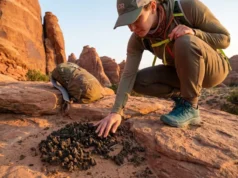
I’ve seen it myself. Catholes dug in Colorado’s alpine tundra contain recognizable toilet paper years after deposition. The freeze-thaw cycles that characterize these zones act as preservatives. Your waste isn’t breaking down—it’s getting mummified.
Desert environments have a different problem: no water. Without sufficient soil moisture, the hydrolysis necessary for enzymatic breakdown cannot occur. Waste buried in sandy soil in places like Canyonlands mummifies rather than decays. Worse, digging a cathole in desert terrain often destroys cryptobiotic soil—those dark, crusty surfaces made of cyanobacteria, lichens, and mosses that take decades to recover.
Pro tip: If you can’t find 6 inches of dark, organic-smelling soil, the terrain is telling you to pack it out. Rocky, sandy, or frozen ground means burial isn’t an option.
The Glacier Time Bomb: Denali’s Warning
The most extreme example comes from Denali. Research by Loso et al. demonstrated that glaciers don’t grind up waste—they encapsulate it. The 88 metric tons of human waste deposited on the Kahiltna Glacier are moving downstream and will emerge in the ablation zone within 50 to 200 years. That waste won’t be decomposed. It will emerge as biologically active raw sewage, contaminating the braided rivers flowing from the glacier.
This glacial transport research on Denali led directly to Denali’s mandatory Clean Mountain Can program, which has successfully removed tons of waste from the mountain annually.
The Pathogen Persistence Problem
Even where burial seems viable, modern human waste creates problems our grandparents didn’t face. Our waste contains high concentrations of pharmaceuticals, endocrine disruptors, and antibiotic-resistant bacteria. These compounds don’t break down with the organic matter—they persist in soil and can transfer to groundwater.
Case studies from the Slate River in Crested Butte show rising E. coli levels directly linked to dispersed camping waste burial. Animas River testing found human waste markers in 70-100% of samples. High-alpine lakes assumed to be pristine are testing positive for Giardia and Cryptosporidium because thin-soiled granite environments don’t filter runoff—snowmelt washes pathogens directly from shallow catholes into surface water.
For reliable protection on trail, understanding water treatment protocols becomes essential.
The Decision Framework: Cathole vs. Pack-Out by Environment
Knowing when to dig and when to bag comes down to four factors: soil type, elevation, traffic density, and regulations. Here’s how to assess each.
The 4-Factor Assessment
Soil type is your primary indicator. Organic forest soil with 6+ inches of depth and visible decomposing material = cathole viable. Rocky alpine terrain, sand, frozen ground, or anything that requires hacking with your trowel = pack it out.
Elevation matters because it correlates with soil biology. Above treeline or in permafrost zones, microbial activity drops to near zero. Below treeline in temperate forests, decomposition works as designed.
Traffic density can overwhelm even viable soil. High-use areas exceeding 20 users per day saturate the soil’s decomposition capacity. Popular backcountry camps that see heavy traffic need pack-out protocols even if the soil looks viable.
Regulations override everything else. Mandatory pack-out zones include Mt. Whitney, Canyonlands, Denali, Mt. Rainier, Guadalupe Mountains, and Zion Narrows. Check permit requirements before your trip—many high-use areas now issue WAG bags with backpacking permits.
Where Pack-Out Is Mandatory
The current federal map of mandatory pack-out zones keeps expanding. The Bureau of Land Management’s waste disposal guidance outlines these requirements clearly:
- Mt. Whitney (CA): WAG bags issued with permits; alpine granite offers zero soil
- Canyonlands (UT): Required throughout backcountry; cryptobiotic soil protection plus river corridor hygiene
- Denali (AK): Clean Mountain Can mandatory; glacial preservation imperative
- Mt. Rainier (WA): Blue Bag system at Camp Muir and Camp Schurman, costing NPS approximately $20,000 annually in helicopter removal
- Guadalupe Mountains (TX): Landfill-safe bag required throughout wilderness
- Zion Narrows (UT): Slot canyon hydrology offers zero containment
These regulations align with broader Leave No Trace principles that frame waste disposal as fundamental stewardship.
When Catholes Still Make Sense
Catholes remain viable in low-traffic wilderness below treeline with deep organic soil. The protocol hasn’t changed: dig 6-8 inches deep (measured, not eyeballed), at least 200 feet from water, trails, and camp. Use a dedicated garden trowel with depth markings—if you’re guessing 6 inches, you’re probably at 4.
Even in viable cathole territory, pack out your toilet paper. TP decomposes far slower than fecal matter and creates the visible litter that turns pristine sites ugly.
Pro tip: Carry a sealable plastic bag specifically for used toilet paper, separate from your WAG bag. This lets you use catholes for waste while still packing out TP—a hybrid approach for below-treeline camping trips.
Pack-Out Systems Compared: WAG Bags, Restop, PACT, and DIY Tubes
Commercial pack-out systems have evolved significantly. Understanding the chemistry inside each system helps you match the right bag to your environment and trip length.
How Gelling Technology Works
The core of most WAG bags is a superabsorbent polymer (SAP), typically sodium polyacrylate. When this powder contacts liquid waste, it undergoes a cross-linking reaction, absorbing up to 300 times its weight in water. This transforms sloshing liquid into stable gel that won’t leak.
Advanced powders include enzymatic agents that initiate organic breakdown, plus pH modifiers that suppress the volatile compounds responsible for odor. NASA originally developed this “Poo Powder” technology for space missions. When treated, the gel classifies as Group 2 Municipal Solid Waste per EPA standards—legal for standard landfill disposal.
Product Comparison: Which System Fits Your Trip?
Cleanwaste WAG Bag (~$3.00, 2.4 oz) is the standard-issue option for most permits. The traditional design works well but can be messy to reuse, and outer bag seal failure is the most common failure mode.
Restop RS2 (~$4.00, 2.6 oz) uses a Mylar barrier that provides superior odor control. It’s heavier but worth it for river trips and humid conditions where odor management matters most.
Biffy Bag (~$3.00, 1.0 oz) offers the lightest footprint for ultralight hikers, but single-use design and deployment complexity make it best for experienced users.
PACT Outdoors (~$3.00, 1.4 oz) takes a different approach. Their system uses mycelium tablets that colonize fecal matter, reducing decomposition time from years to weeks where burial is permitted. Field studies show E. coli elimination through fungal competitive exclusion. PACT also provides dehydrated cellulose wipes that serve as initial food for the mycelium.
For foundational waste practices, review proper cathole technique before choosing your system.
The DIY Poop Tube for Big Wall and Canyoneering
For extended technical routes where soft bags risk puncture, the homemade poop tube is essential. Standard construction uses 4-inch Schedule 40 PVC pipe: one end sealed with a permanent glued cap, the other fitted with a threaded cleanout adapter and screw plug.
Add a tether for clipping to haul bags, and line the bottom with kitty litter or dry bleach to absorb leakage and neutralize odors. The rigid shell allows WAG bags inside to be compressed without rupture risk—critical for 3-7 day wall climbs where you’re managing a week’s worth of waste in limited space.
Common Failures and How to Prevent Them
Understanding why pack-out systems fail helps you avoid becoming another cautionary tale on a ranger’s incident report.
The “Abandoned Bag” Psychology
Field rangers in the Sierra Nevada report a paradox: hikers use WAG bags but then abandon them on trail. This behavior stems from the “yuck factor”—the physical reality of carrying human waste for several days overcomes ethical commitment.
The common pattern: “I’ll pick it up on the way down” transforms into forgotten or intentionally ignored. These abandoned bags are worse than catholes because they prevent all decomposition, preserve waste in plastic, and attract marmots that tear them open—scattering micro-trash and raw sewage across the landscape.
The mental shift isn’t carrying it—it’s accepting that you’re carrying it. Once you reframe the WAG bag as just another piece of gear, like a dirty pot or sweaty shirt, the aversion fades.
Mechanical Failures: Altitude Expansion and Punctures
Gas build-up at altitude causes bag expansion. If you don’t “burp” the bag (which releases odor), it can rupture inside your backpack. Storing soft WAG bags near crampons, tent stakes, or in compression sacks commonly leads to puncture.
Prevention is straightforward: give your waste kit a dedicated stuff sack, separated from sharp objects. Never compress it. A rigid poop tube eliminates puncture risk entirely for extended trips.
Despite “multiple use” claims, a single significant use often reaches bag capacity, especially at altitude where digestive issues are common. Reusing a near-full bag invites spills and seal failure.
Pro tip: Carry one more WAG bag than you think you need. Extra weight is negligible; ruining your pack interior is not. Plan for one bag per day plus a spare.
The Hidden Hazard: “Biodegradable” Wipes
Most commercial wet wipes—even those marketed as “flushable”—contain synthetic thermoplastics (polyester/polypropylene) that render them non-biodegradable. Buried wipes fragment into microplastics. Research has identified white microplastic fibers from hygiene products as significant aquatic pollutants in sediments.
True biodegradability requires 100% cellulosic fibers—cotton, bamboo, or wood pulp—with no synthetic binders. PACT Outdoors uses compressed, dehydrated cellulose tabs that expand with water, eliminating the plastic matrix entirely. Biodegradable wipes that actually break down do exist—but you have to verify the materials.
If you can’t verify a wipe is 100% plant fiber, pack it out. It’s going in the WAG bag anyway.
After the Trail: Legal Disposal and Post-Trip Logistics
The question nobody else answers: you packed it out—now what?
Why Treated WAG Bags Are Landfill-Legal
Commercial WAG bags use gelling powder that treats waste sufficiently to classify as Group 2 Municipal Solid Waste per EPA standards. This makes disposal in standard landfills legal at the federal level.
Local regulations vary, but most follow similar logic. Seattle’s municipal code prohibits disposal of human excrement in garbage unless it’s contained—which makes a sealed WAG bag legally equivalent to a diaper. Portland applies similar standards.
The key legal standard is “contained and stabilized.” A sealed, treated bag meets this threshold. Do NOT dispose of bags in recycling bins, composting, or storm drains.
Gateway City Disposal Points
High-use trailheads increasingly provide dedicated infrastructure:
- Mt. Whitney: “Human Waste Only” dumpsters at portal
- Moab (Grand County, UT): WAG bag-specific bins at multiple trailheads
- River corridors (Rogue, etc.): BLM “SCAT Machines” that clean reusable containers like Groover systems
When no dedicated bin exists, treated and sealed WAG bags can go in standard municipal landfill trash. Double-bag if concerned about sanitation worker exposure, but single bags with intact seals are designed for this disposal path.
Before leaving a trailhead, locate the waste bin. Knowing where your bag ends up makes carrying it psychologically easier. This connects to broader microtrash stewardship practices that close the loop on all backcountry waste.
Indigenous Perspectives: Waste as Desecration
The discourse on wilderness waste typically focuses on pathogens and aesthetics. For Indigenous communities, the issue runs deeper—waste deposition on sacred land is a spiritual violation, not merely a hygiene issue.
Beyond Hygiene: The Spiritual Dimension
The San Francisco Peaks in Arizona illustrate this powerfully. To the Hopi and Navajo, these peaks are a living spiritual entity—home to the Kachina spirits. The Snowbowl ski resort’s use of treated wastewater for artificial snow, while “clean” by EPA standards, represents profound desecration to Indigenous leaders.
Navajo spokespersons have compared it to “flushing the Koran down the toilet.” Chemical treatment cannot neutralize the spiritual contamination that human waste represents on sacred ground.
In New Zealand, Ngāi Tahu view Aoraki (Mount Cook) as an ancestor. Under the Ngāi Tahu Settlement Claims Act, the mountain’s sacred status is legally recognized. The Department of Conservation collaborates with Ngāi Tahu to educate climbers, framing pack it out as tikanga—protocol for respecting the ancestor, not just following an environmental rule. This perspective connects to understanding the Indigenous history of our national parks.
When I learned to see a mountain not as “wilderness” but as someone else’s sacred relative, pack it in pack it out stopped feeling like a regulation and started feeling like basic respect.
Conclusion
Pack it in, pack it out evolves from mantra to mandate as you move from forest floor to alpine zone. The cathole works in organic soil below treeline with low traffic—but fails catastrophically on granite, desert, and glacier. Your containment system is non-negotiable gear: match the bag to the environment, protect it from puncture, and know where the bin is before your boots hit the trail.
On your next alpine trip, skip the internal debate. Pack the WAG bag, carry it out, and notice how little it matters once you accept it as part of the kit. The mountain—and whoever considers it sacred—stays clean because you closed the loop.
FAQ
What does pack it in, pack it out mean?
Pack it in, pack it out means carrying out all trash, leftover food, litter, toilet paper, and—in fragile environments—human waste that you brought or produced in the backcountry. Nothing you brought in stays behind, and nothing you produced gets buried in environments where decomposition fails.
Can you bury toilet paper when hiking?
In pack-out zones, no—toilet paper must be packed out with waste. In cathole-viable areas with deep organic soil, you can bury unbleached, unperfumed TP, but best practice is to pack it out everywhere since TP decomposes far slower than waste.
How do you pack out human waste?
Use a commercial WAG bag with gelling powder. Defecate into the inner bag, add powder to solidify liquids, seal it, then seal inside the outer bag. Store in a dedicated stuff sack away from sharp objects. Dispose at trailhead waste bins or municipal landfill upon return.
What is a WAG bag?
WAG stands for Waste Alleviation and Gelling. It’s a two-bag system with superabsorbent polymer powder that transforms liquid waste into stable gel, reduces odor, and meets EPA standards for municipal landfill disposal.
Where do you throw away WAG bags?
At dedicated trailhead waste receptacles where available (Mt. Whitney, Moab). When no dedicated bin exists, treated and sealed WAG bags can be disposed of in standard municipal landfill trash—the gelling treatment classifies them as Group 2 Municipal Solid Waste.
Risk Disclaimer: Hiking, trekking, backpacking, and all related outdoor activities involve inherent risks which may result in serious injury, illness, or death. The information provided on The Hiking Tribe is for educational and informational purposes only. While we strive for accuracy, information on trails, gear, techniques, and safety is not a substitute for your own best judgment and thorough preparation. Trail conditions, weather, and other environmental factors change rapidly and may differ from what is described on this site. Always check with official sources like park services for the most current alerts and conditions. Never undertake a hike beyond your abilities and always be prepared for the unexpected. By using this website, you agree that you are solely responsible for your own safety. Any reliance you place on our content is strictly at your own risk, and you assume all liability for your actions and decisions in the outdoors. The Hiking Tribe and its authors will not be held liable for any injury, damage, or loss sustained in connection with the use of the information herein.
Affiliate Disclosure: We are a participant in the Amazon Services LLC Associates Program, an affiliate advertising program designed to provide a means for us to earn advertising fees by advertising and linking to Amazon.com. As an Amazon Associate, we earn from qualifying purchases. We also participate in other affiliate programs and may receive a commission on products purchased through our links, at no extra cost to you. Additional terms are found in the terms of service.