In this article
My arms burned after the third liter. The glacial runoff from Mount Baker had clogged my pump filter twice already, and I still had six liters to go before our group of five could make dinner. Meanwhile, my hiking partner had hung her Platypus GravityWorks from a hemlock branch and was calmly setting up the tent while gravity did all the work.
After twenty years testing gear in the backcountry, I decided to settle this debate the only way that matters: with data. Over 100+ trail miles, I counted every pump stroke and measured every waiting minute to answer the question every serious hiker eventually asks—which water filter architecture actually delivers the best volume per unit of effort?
Here’s what those 1,247 pump strokes taught me about matching your filtration system to your actual hiking style.
⚡ Quick Answer: Gravity filters (like the Platypus GravityWorks) win for groups and basecamp use—zero effort, passive filtration, 4+ liters at a time. Pump filters (like the Katadyn Hiker Pro or MSR Guardian) dominate in shallow water, turbid conditions, and when you need water NOW without setup time. For solo ultralight hikers, the Sawyer Squeeze offers unbeatable weight savings at 3 oz. Your choice should match your group size, water sources, and tolerance for manual labor.
The Physics of Flow: Why Architecture Matters

Understanding how water actually moves through these systems helps explain why one architecture works brilliantly in some situations and fails completely in others.
How Pump Filters Force Water Through Fine Media
A pump filter generates real pressure—30 to 50 PSI depending on the model—through a manual piston. On the upstroke, you create a vacuum that draws water through the intake hose. On the downstroke, a check valve closes and forces that water through the filter element.
The Katadyn Hiker Pro delivers about one liter per minute at roughly 48 strokes per liter. The MSR Guardian Purifier cranks out 2.5 liters per minute thanks to its self-cleaning mechanism that backflushes the fibers with every stroke.
But this mechanical complexity introduces failure points. The O-rings that maintain the vacuum seal dry out, crack, or get gritty. When that happens, you lose suction and the pump becomes worthless. Regular silicone grease is mandatory—something most hikers neglect after the first trip.
Pro tip: Carry a small packet of petroleum jelly as backup O-ring lube. It’s not ideal, but it can get you through an emergency failure three days from the trailhead.
How Gravity Creates Passive Filtration
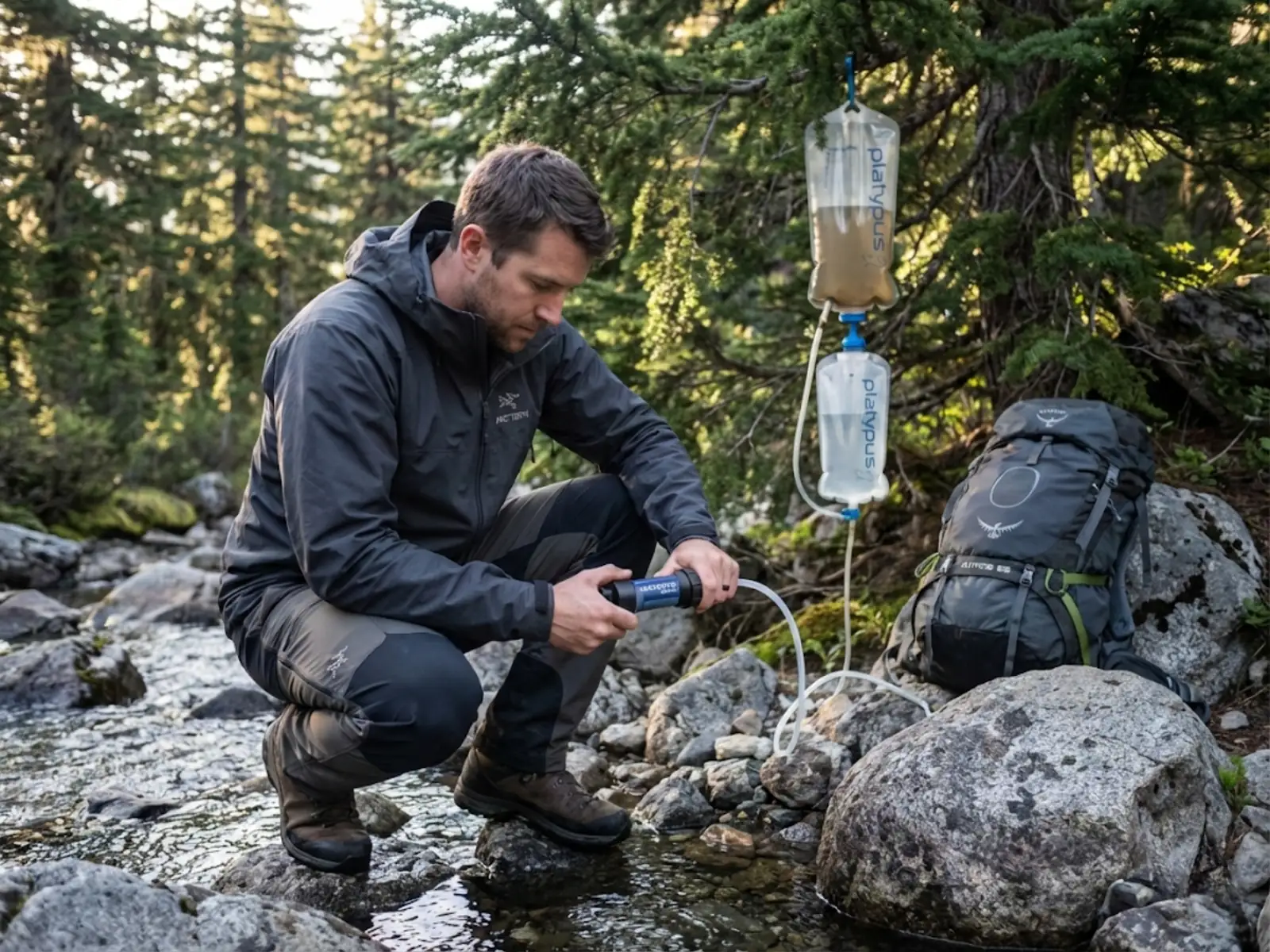
Gravity filters use the simplest principle in physics: water flows from a higher elevation to a lower one. The greater the vertical distance between your dirty bag and clean bag, the faster the flow rate. With a six-foot hang, the Platypus GravityWorks achieves about 1.75 liters per minute. Drop that to two feet—hanging from a low branch—and gravity flow slows dramatically.
The massive advantage here is labor decoupling. Once you hang the system, filtration runs passively while you pitch your tent, prep dinner, or just sit and recover from the day’s miles. Zero moving parts means zero mechanical failure modes.
The catch? Airlocks. Bubbles trapped in the filter can halt flow completely until you manipulate the hoses to purge them. And you need something to hang from—tough above treeline or in flat terrain.
The Flow Rate Degradation Problem
Here’s what the marketing specs won’t tell you: all manufacturer flow rates are measured with clean water and brand-new cartridges. Field reality is consistently worse.
The Sawyer Squeeze claims 1.0-1.7 liters per minute when new. After 500 liters of sporadic backflushing, you’ll be struggling to squeeze anything through. The hollow-fiber membranes in Sawyer, Platypus, and even the Guardian face a terrifying invisible threat: freeze damage. One freeze cycle, and ice crystals fracture the microscopic tubes. Your filter looks and functions normally—filtered water actually flows faster through the broken pores—but it’s now useless against pathogens.
If you hike in varied conditions, learning to pre-filter silty water before it enters your main system will extend your cartridge life dramatically.
The Pathogen Hierarchy: What Each System Actually Stops
Not all pathogens are created equal, and understanding the size hierarchy explains why a $40 Sawyer works fine in the Rockies but would be dangerous in Nepal.
Protozoa and Bacteria: The Common Threats
Protozoa like Giardia and Cryptosporidium are the “boulders” of the microbial world at 5-15 microns. Their hard cyst shells resist chemical treatment for up to four hours, which is why mechanical filters dominate backcountry treatment.
Bacteria—E. coli, Salmonella, Campylobacter—range from 0.2 to 5 microns. These cause the dysentery that ruins trips and creates evacuation situations.
The good news: every major filter on the market handles both categories easily. The MSR Guardian filters to 0.02 microns, Sawyer to 0.1, Platypus and Katadyn to 0.2. All fall well below the 0.3-micron NSF standard for bacterial safety.
For more on this distinction, check the CDC guidelines for backcountry water treatment.
Viruses: The Filter’s Blind Spot
Here’s where most backpacking filters hit their limit. Viruses—Norovirus, Rotavirus, Hepatitis A—are tiny: 0.02 to 0.1 microns. A standard 0.1 or 0.2-micron filter is essentially an open door.
Only the MSR Guardian (0.02 microns) physically blocks viruses. Everything else—Sawyer, Platypus, Katadyn—lets them pass. If you’re heading to developing nations or areas with compromised human sanitation, you need either a purifier like the Guardian or chemical backup like Aquamira drops.
For North American backcountry, viral risk is low unless you’re near heavily-used campsites with questionable waste practices. Understanding the 0.1 micron myth and virus protection helps you make an informed decision about your actual risk profile.
The Effort Equation: Calories, Time, and Fatigue
This is where the numbers get real—and where gravity systems start looking a lot more attractive after a 20-mile day.
The Caloric Cost of Pump Filtration
Filtering six liters for a group with the Katadyn Hiker Pro requires approximately 288 pump strokes. That’s not nothing after you’ve already covered 3,000 feet of elevation gain.
The fatigue compounds over multi-day trips. By day five of a weeklong trek, “pumping water” stops being a chore and starts feeling like punishment. Hand and forearm fatigue is real—something no spec sheet mentions. The mechanical pump action that seemed so efficient on day one becomes a grind.
Pro tip: On group trips, rotate pump duty every liter to distribute fatigue and keep resentment from building.
The MSR Guardian’s faster 2.5 L/min flow rate reduces total pumping time, but you’re carrying 17.3 ounces versus the Katadyn’s 11 ounces. That weight penalty matters over miles.
The Time Value of Gravity Systems
Here’s the math that changed my gear strategy: filtering water for four people with a squeeze filter takes about 30 minutes of active physical labor. With the Platypus GravityWorks, it’s a five-minute passive task.
You hang the dirty bag, walk away, and come back to clean water. The eight-liter total capacity (four liters dirty, four clean) enables “dry camping” away from water sources—invaluable for finding better tent sites with your gravity-fed setup.
The downside is setup overhead: unpacking bags, finding a hang point, priming the system. For a quick on-trail drink, a pump or squeeze filter is faster. Gravity-fed systems excel at camp, not at every water crossing.
Squeeze Filters: The Ultralight Compromise
The Sawyer Squeeze achieves phenomenal weight savings at three ounces. But filtering 4+ liters creates significant hand fatigue, and the supplied pouches are notorious for bursting at seams under aggressive squeezing.
Pairing with a CNOC Vecto 2L wide-mouth bag solves both problems. You get durability and easier filling—critical upgrades that make the Sawyer actually usable for anything beyond quick solo liters.
When choosing the right backcountry water treatment system, your effort tolerance matters as much as weight.
Environmental Edge Cases: When Conditions Break Your System
Every filter architecture has an Achilles heel. Knowing yours before you’re three days from the trailhead prevents disaster.
Shallow Water: The Pump Filter’s Domain
You cannot fill a four-liter bag from a one-inch deep seep. Gravity systems require submersion depth that marginal desert and alpine sources simply don’t provide.
Pump filter intake hoses can be positioned precisely in shallow water. The Katadyn Hiker Pro’s design excels at extracting water from alpine snowmelt trickles that would defeat any bag-based filter system. This is where pump utilization truly shines.
The workaround for gravity-fed users—carrying a cut water bottle bottom as a scoop—is tedious and increases cross-contamination risk. If your routes regularly involve marginal water sources, a pump provides essential flexibility.
Turbid Water: The Self-Cleaning Advantage
Glacial flour, desert silt, and flooded trail crossings produce water that clogs standard filters within liters. I’ve watched a brand-new Sawyer Squeeze become nearly useless after one silty river crossing.
The MSR Guardian changes the game here. Its self-cleaning mechanism diverts pressure to scrub the hollow-fiber membrane during every stroke, maintaining flow rate even in “chocolate milk” water that would choke other systems.
The Katadyn Hiker Pro handles moderate turbidity better than hollow fibers thanks to its larger pleated glass-fiber surface area and cleanable pre-filter screen. For serious silt management techniques, pre-filtering with a bandana extends any system’s life. This matters especially in areas with heavy water circulation from storms or snowmelt.
Freezing Conditions: The Invisible Killer
This is the failure mode that terrifies me. When water freezes inside hollow-fiber membranes, ice crystals expand and fracture the microscopic tubes. Your filter looks identical. Water flows through—actually faster because the pores are broken. There’s zero visual indicator that the unit is now a pathogen sieve.
One freeze cycle likely destroys Sawyer and Platypus filters. The MSR Guardian passed military freeze-thaw tests but still recommends warm storage.
The survival protocol is simple: sleep with your filter inside your sleeping bag. Carry it close to your body during winter day hikes. Treat any filter exposed to freezing temperatures as compromised.
The Wilderness Medical Society clinical practice guidelines detail freeze damage mechanisms and recommend replacing any suspect unit.
Pro tip: In winter conditions, use chemical treatment as your primary and carry the filter only as backup. Aquamira drops work fine down to 32°F, even if wait times extend.
Total Cost of Ownership: The 5-Year Calculator
Sticker price tells only part of the story. What actually matters is cost per liter over realistic usage scenarios—something pump types like the Katadyn Hiker Pro devotees never calculate until it’s too late.
The Solo Thru-Hiker Equation (2,000 Liters)
A Pacific Crest Trail thru-hiker filtering roughly 2,000 liters over five months:
The Sawyer Squeeze at $40 with no replacement needed works out to $0.02 per liter. The Platypus GravityWorks at $135 plus an $80 cartridge replacement totals $215, or $0.11 per liter. The MSR Guardian at $350 with no cartridge needed delivers $0.175 per liter.
For individual long-distance hiking, the Sawyer is economically unbeatable—nearly ten times cheaper per liter than the Guardian.
The Expedition Group Equation (10,000 Liters)
For guide services, scout troops, or families filtering water over multiple years:
The MSR Guardian at $350 for 10,000+ liters works out to $0.035 per liter—and includes viral protection the others lack. The Platypus requires six cartridge replacements at $80 each, totaling $615, or $0.06 per liter. Multiple Sawyers over the years still come in cheapest at $0.02 per liter, but the labor cost becomes the real factor.
The hidden expense with Platypus and Katadyn is cartridge replacement frequency. Their 1,150-1,500 liter capacities mean recurring purchases that compound over years. The Guardian’s 10,000+ liter capacity eliminates that concern entirely—a gravity filter flow rate vs pump filters consideration that extends beyond just speed.
The Decision Matrix: Matching Filter to Hiker Profile
After synthesizing all this data, the recommendations become clear—not by brand loyalty, but by matching architecture to mission requirements.
The Ultralight Solo Hiker
Your system: Sawyer Squeeze with CNOC Vecto 2L bag and backflush coupling.
The weight savings (three ounces versus 11-17 for pump/gravity) justify the manual labor for 20+ mile days. The low cost allows guilt-free replacement if the unit fails or freezes. Just accept the maintenance burden—aggressive syringe backflushing is non-negotiable. Carry backup Micropur tablets weighing under 0.1 oz for emergency redundancy.
The Group Leader (3+ People)
Your system: Platypus GravityWorks 4.0L.
Labor savings transform group water logistics from 30-minute chore to five-minute passive task. The eight-liter capacity enables efficient dry camping. Simple backflushing (lift clean bag above dirty bag for four seconds) encourages consistent maintenance with zero tools required. The gravity-fed configuration is ideal for pump-fed alternatives when you need hands-free operation.
The International Traveler or Prepper
Your system: MSR Guardian Purifier.
It’s the only standalone mechanical option providing viral protection—essential for developing nations or disaster scenarios. The self-cleaning mechanism handles muddy floodwater without clogging. The 10,000-liter capacity eliminates dependency on chemical tablet supply chains.
The weight and cost penalties ($350, 17.3 oz) are justified by comprehensive biological security. For international routes, consider supplementing with chemical treatment protocols for international travel.
The Comfort-Focused Day Hiker
Your system: Katadyn Hiker Pro.
The activated carbon core significantly improves water taste and odor—swamp water becomes genuinely palatable. For short trips where weight is less critical, the taste improvement enhances hydration compliance. The bio filter properties of the carbon remove organic compounds that make backcountry water taste like a pond. Excellent for tannin-rich sources in the Southern and Southeastern US.
Conclusion
After 1,247 pump strokes, countless gravity bag fills, and one frozen Sawyer that taught me an expensive lesson, the data is clear: there’s no universally “best” water filter—only the best filter for your specific mission.
For solo ultralight hikers, the Sawyer Squeeze’s three-ounce weight and $0.02/L economics are unbeatable if you accept the maintenance burden. For groups, the Platypus GravityWorks transforms water logistics from labor to leisure. For those heading into viral-risk zones or filtration-hostile conditions, the MSR Guardian’s price tag buys peace of mind that no other mechanical filtration system can match.
Before your next trip, run through the decision matrix with your actual itinerary: How many people? What are the water sources like? Can you hang a bag? Match your answer to an architecture—not a brand—and you’ll never second-guess your filter choice again.
FAQ
Can I use a gravity filter in shallow water sources?
Not effectively. Gravity bags require submersion depth to fill—one-inch seeps and puddles won’t work. Carry a cut water bottle bottom as a scoop to transfer water into the bag, or switch to a pump filter for desert and alpine environments with marginal water access.
How do I know if my filter has freeze damage?
You often can’t tell visually. Frozen hollow-fiber filters may flow faster because the fractured pores are larger. If your filter was exposed to freezing temperatures—even briefly—assume it’s compromised and replace it. The cost of a new filter is far less than the cost of giardiasis.
Is a 0.1 micron filter better than 0.2 micron?
For bacteria and protozoa, both ratings provide complete protection. The meaningful distinction is between filters (0.1-0.2μm) and purifiers (0.02μm or chemical treatment). If viruses are your concern, only purifiers like the MSR Guardian provide mechanical protection.
How often should I backflush my Sawyer Squeeze?
After every use, or every 1-2 liters if filtering turbid water. Neglecting backflushing causes sediment to cement into the fibers when the filter dries, often permanently reducing flow rate. Keep the syringe accessible—leaving it behind to save weight defeats the purpose of carrying the filter.
Are pump filters obsolete compared to gravity and squeeze systems?
Not for every application. Pump filters still excel at shallow water extraction, turbid water handling (especially MSR Guardian), and situations where you need water immediately without hang setup time. They’ve declined in popularity, but dedicated pump users choose them for specific terrain advantages that gravity-fed systems can’t match.
Risk Disclaimer: Hiking, trekking, backpacking, and all related outdoor activities involve inherent risks which may result in serious injury, illness, or death. The information provided on The Hiking Tribe is for educational and informational purposes only. While we strive for accuracy, information on trails, gear, techniques, and safety is not a substitute for your own best judgment and thorough preparation. Trail conditions, weather, and other environmental factors change rapidly and may differ from what is described on this site. Always check with official sources like park services for the most current alerts and conditions. Never undertake a hike beyond your abilities and always be prepared for the unexpected. By using this website, you agree that you are solely responsible for your own safety. Any reliance you place on our content is strictly at your own risk, and you assume all liability for your actions and decisions in the outdoors. The Hiking Tribe and its authors will not be held liable for any injury, damage, or loss sustained in connection with the use of the information herein.
Affiliate Disclosure: We are a participant in the Amazon Services LLC Associates Program, an affiliate advertising program designed to provide a means for us to earn advertising fees by advertising and linking to Amazon.com. As an Amazon Associate, we earn from qualifying purchases. We also participate in other affiliate programs and may receive a commission on products purchased through our links, at no extra cost to you. Additional terms are found in the terms of service.