

In this article
The plastic buckle was digging into my collarbone as I tried—for the third time—to get my frozen lips around the tiny mouthpiece. My ankle was twisted somewhere on the descent of Wheeler Peak, the sun was dropping fast, and my phone showed zero signal. The shrill screech that finally escaped was so thin, so pitiful against the wind roaring through the pines, that I knew instantly: this little sternum strap buckle wasn’t going to save me.
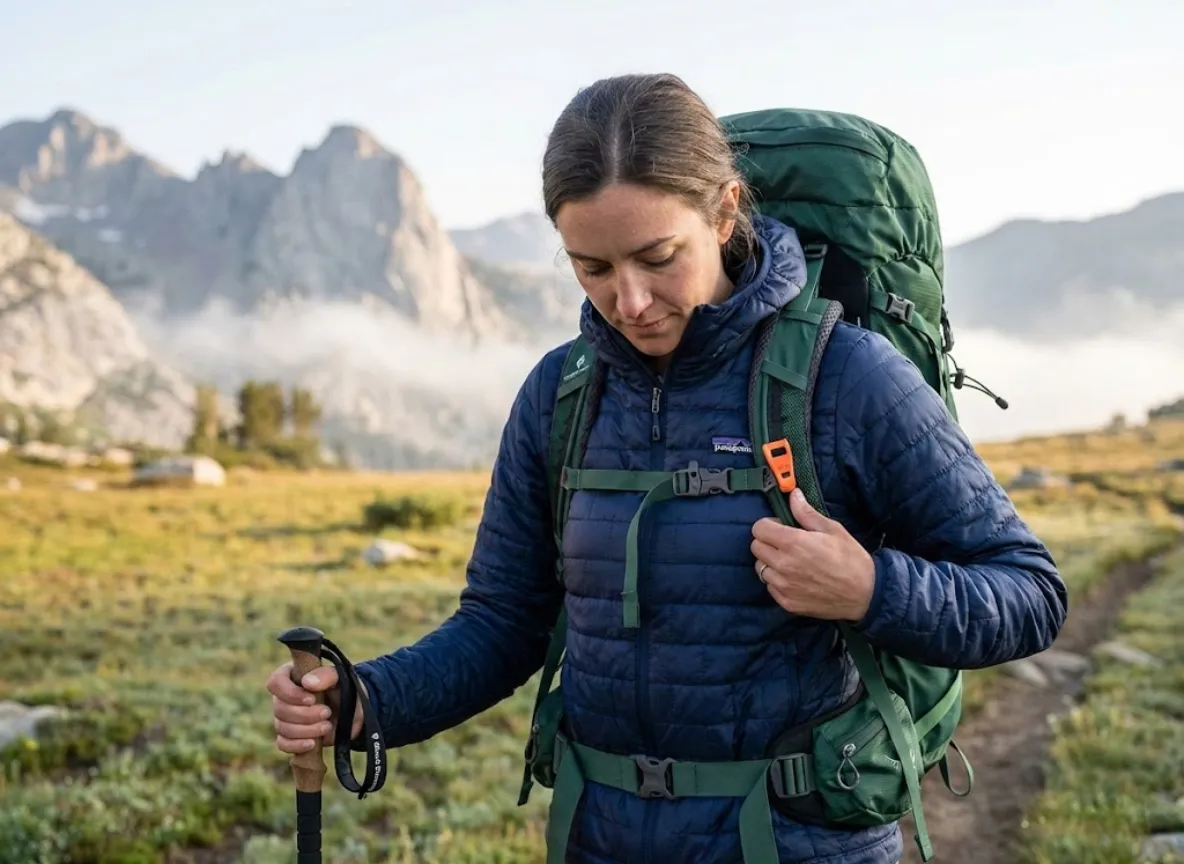
I was eight months into owning an expensive Osprey pack before I even discovered that “hidden” safety whistle integrated into my chest strap. Most hikers are the same—they find it and think, “Oh, cool, I’m covered.” After fifteen years on these trails, I can tell you: they’re not. Not really. Here’s exactly why the physics of that little buckle work against you, what the numbers actually mean, and how to build a signaling system that might actually bring help when you need it.
⚡ Quick Answer: Sternum strap whistles typically produce 100-106 dB—enough to meet ISO safety standards but far short of the 115-130 dB output of dedicated emergency whistles like the Fox 40 or Storm Windstorm. That difference means your buckle whistle may only carry half a mile in forest terrain, while a standalone whistle can reach 1.5-2 miles—quadrupling your search area. Keep your buckle whistle as backup, but clip a $6 dedicated whistle to your shoulder strap before every hike.
The Hard Physics of Whistle Decibels

Why 100 dB vs. 120 dB Isn’t a 20% Difference
Here’s the thing most hikers don’t understand about decibel range: the scale is logarithmic, not linear. Every 10 dB increase represents a tenfold increase in sound intensity—and roughly a doubling of perceived loudness to your ears. That means the difference between a 100 dB sternum whistle and a 120 dB Storm Whistle isn’t a minor bump. It’s a hundredfold increase in acoustic energy.
Your buckle whistle at 100-106 dB is roughly equivalent to a motorcycle engine or handheld power drill. Loud at close range? Sure. But easily masked by wind, river noise, or dense vegetation. A Fox 40 Classic at 115 dB starts approaching rock concert levels. The Storm at 120-130 dB nears the threshold of pain—comparable to a jet engine at takeoff or a gunshot.
Pro tip: Most people have never actually tested their buckle whistle until an emergency—only to discover it’s clogged with trail mix crumbs or requires more breath than they can muster. Give yours a test blast before your next trip.
The Inverse Square Law: How Distance Kills Your Signal
Sound pressure level drops approximately 6 dB for every doubling of distance in open terrain. That’s physics working against you. A 100 dB sternum whistle may drop to ambient noise levels—that 40-50 dB of a quiet forest—within half a mile to three-quarters of a mile. In heavy vegetation or near a rushing stream, the effective sound distance shrinks even further.
A 120 dB dedicated whistle, starting with vastly more energy, can sustain audible levels out to 1.5-2 miles. In a rescue scenario, that additional range effectively quadruples the search area covered by your signal. That’s the difference between summoning help from the trail 500 yards away or reaching SAR in the valley floor.
This is why understanding emergency signaling in the Ten Essentials matters. Your whistle isn’t just gear—it’s a communication tool with hard physical limits.
Frequency Matters: Why High-Pitched Screeches Fade Faster
The size of your buckle constrains everything. Sternum whistles produce very high-frequency tones—typically 3500-5000 Hz—because their tiny resonance chambers can’t generate longer wavelengths. That’s a problem.
High-frequency sounds are more susceptible to atmospheric absorption. Humidity and temperature affect how fast sound energy converts to heat as it vibrates air molecules. High frequencies also struggle to diffract—bend around obstacles. In a dense forest, a 4000 Hz signal scatters and absorbs into tree trunks, leaves, and pine needles. New Zealand SAR research confirmed this “bush effect”: whistles audible over 600 meters in open terrain dropped significantly in vegetation.
The monotone screech of pealess buckle whistles can also be mistaken for bird calls. Compare that to the Fox 40’s tri-tone design, which produces sound at three frequencies simultaneously. If one gets masked by wind, another might punch through. That multi-frequency redundancy is completely absent in single-chamber sternum whistles.
Inside Your Buckle: Engineering That Limits Performance
Acetal vs. Polypropylene: Material Science of Buckle Acoustics
Not all buckles are created equal. The material matters for both durability and sound production. Acetal (Polyoxymethylene or POM) is the gold standard for premium backpack hardware. It’s dense and rigid, which means the walls of the whistle chamber vibrate less, directing more energy into the air column rather than absorbing it. Acetal buckles from manufacturers like Woojin Plastic and YKK are prized for their “snap” and temperature stability from -40°F to 347°F.
Polypropylene (PP) is softer, often used in cheaper gear or marine applications where buoyancy matters. ITW Nexus produces marine whistles in polypropylene specifically so they float. But that softer material dampens sound. Worse, PP becomes brittle at extreme cold—posing a shatter risk in alpine conditions. Check for manufacturer markings on your buckle. “WJ” indicates Woojin. “ITW” may be acetal or PP depending on the product line.
The OEM Hierarchy: Woojin, ITW Nexus, and YKK
Here’s something most hikers don’t realize: Osprey, Gregory, Dakine, and Patagonia rarely manufacture their own hardware. They source it from specialized OEMs—Original Equipment Manufacturers. Woojin Plastic out of Korea is the dominant supplier for premium packs, including most Osprey models. Their “Y-Buckle” and sternum system designs integrate the whistle while hiding the mouthpiece to prevent snagging.
ITW Nexus invented the side-release buckle (Fastex) and dominates military and marine sectors. Their WhistleLoc series meets ISO/SOLAS standards but tends bulkier. YKK—famous for zippers—produces robust hardware for tactical gear and repair markets. Because Woojin supplies so many brands, the acoustic profile of your Osprey is likely identical to a Gregory or REI Co-op pack using the same OEM part.
The Chamber Volume Problem: Injection Molding Tradeoffs
To keep buckles lightweight and low-profile, the whistle chamber must be flattened. That’s the engineering tradeoff. In dedicated whistles like the Fox 40, chambers are deep and specifically tuned for sound production. In a buckle, the chamber is an afterthought squeezed into available space.
This flattened geometry forces air into turbulent flow—less efficient than the laminar flow of cylindrical chambers. The result? A device that requires higher air pressure to activate. You must blow harder to overcome the inefficient aerodynamics. That creates a dangerous paradox: the device meant to save you when injured or exhausted demands more physical effort than a standalone whistle.
When you’re evaluating pack hardware quality as a new backpacker, the whistle buckle deserves more scrutiny than most people give it.
When Your Body Works Against You: Physiology of Emergency Signaling
Respiratory Compromise: Broken Ribs, Panic, and Hypothermia
Survival scenarios don’t happen when you’re rested and calm. They happen when you’re injured, hypothermic, panicking, or exhausted. Each of these states works directly against your ability to use a sternum strap whistle effectively.
Thoracic injury makes forceful exhalation excruciating. Broken ribs, a punctured lung, or severe bruising mean the high back-pressure of a small-aperture sternum whistle—which demands significant pressure from your lungs—may be beyond what an injured hiker can generate. Panic and hyperventilation trigger rapid, shallow breathing—the opposite of the deep, sustained blast needed to activate a whistle. And hypothermia degrades fine motor control. Sealing frozen lips around a small buckle becomes difficult. The “umbles” set in: stumbles, mumbles, fumbles.
Pro tip: SAR professionals note that many rescued hikers report struggling to operate basic gear due to shaking hands and cognitive impairment from cold. A larger standalone whistle is significantly easier to manipulate with frozen lips and gloved hands.
This section covers what competitors skip entirely: the physiological “what-ifs.” Have you ever tested your whistle one-handed, from the ground, simulating a sprained ankle? That’s injury simulation testing—and it reveals how quickly your backup plan can fail.
The Ergonomic Reality of the “Chin Tuck”
The placement sounds convenient—”right under your chin, always accessible.” But reality is messier. To blow the whistle without unbuckling, you must tuck your chin to your chest. With a loaded pack and tight shoulder straps, the buckle may be pulled taut against your clavicle.
Getting your mouth around the integrated mouthpiece while wearing a bulky jacket or neck gaiter is awkward at best. And if you’ve fallen and are pinned face-down, or immobilized with a potential spinal injury, that fixed chest position becomes inaccessible. A whistle on a lanyard offers range of motion a fixed buckle cannot.
Risk Compensation: The Psychology of Feeling “Safe”
Perhaps the most dangerous aspect is the complacency these buckles breed. Risk Compensation Theory suggests people adjust behavior based on perceived safety. Seeing that whistle icon on your buckle may cause you—consciously or not—to skip packing a dedicated signal device.
The “discovery” moment frames it as a clever bonus rather than recognizing and treating cold-related illness level equipment that needs testing and maintenance. Many users never blow their whistle until an emergency—only to discover the airway is clogged with crumbs.
Built-In vs. Standalone: The Data Showdown
Sternum Strap Whistle Performance: The Hard Numbers
Let’s look at the data. Osprey/Woojin integrated buckles typically rate 100-105 dB based on field reports and the limited manufacturer specifications available. Users consistently describe the sound as “thin” or “breathy” compared to dedicated units.
ITW Nexus marine buckles are more transparent, citing 106 dB(A)—respectable for a secondary device, but measured under ideal conditions. Frequency profile analysis shows peak energy in the 3500-4500 Hz range: the “screech zone” that attenuates rapidly in vegetation.
Effective range in forest environments? Less than half a mile. That 0.5-mile radius covers roughly the immediate trail vicinity—not enough to reach a rescue party working the switchbacks below.
Dedicated Whistles: The Heavy Artillery
The Fox 40 Classic is the benchmark at 115 dB. Its tri-tone design produces sound at three frequencies simultaneously—if one gets masked by wind, another might punch through. That multi-frequency redundancy is critical in variable conditions.
The Storm Windstorm is the heavy artillery. Rated at 120-130 dB, it uses a patented resonance chamber that purges water instantly—working even when submerged. Its lower frequency components (~3000 Hz) are tuned to carry through rainforest and marine environments. Effective range: 1.5-2.0+ miles.
The SOL Rescue Howler at 110 dB offers a bridge option—slim, pealess, significant upgrade for negligible weight penalty. Even budget options outperform most buckle whistles.
The “Trust Gap” Table: Quantifying the Deficit
Here’s the bottom line: a built-in whistle covers approximately 25% of the search area that a Storm whistle covers. Actuation effort is high resistance for buckle whistles versus low resistance for dedicated options—critical for injured users. The fixed chest strap position limits use if you’re pinned or immobilized.
All modern pealess options—including your buckle whistle—are superior to old pea whistles in freezing conditions. No cork ball to freeze. But acoustic performance remains the differentiator.
If you’re thinking about emergency gear for your day pack, a $6 Fox 40 may be the most weight-efficient addition you can make.
Wildlife Encounters: When a Whistle Helps (and When It Hurts)
Bears: The “Prey Mimicry” Risk
Let’s address the elephant—or bear—in the room. Many hikers assume their whistle works as a wildlife deterrent. For bears, this is dangerous misinformation.
The National Park Service and bear experts explicitly advise against using whistles for bear deterrence. A high-pitched, screeching whistle can sound remarkably like a distressed prey animal—a marmot, a fawn. That may attract a curious or predatory bear rather than repel it. Similar to bear bells, which are often too quiet to be effective until the encounter is immediate, a whistle can be interpreted as a challenge.
The human voice is the most effective deterrent. Its low-frequency, complex modulation is distinct from natural forest sounds and identifies you as a non-prey species. Check bear country safety guidelines for proper backcountry protocols.
Mountain Lions: When High-Pitched Screeches Actually Work
The dynamics flip with cougars. Felines have acutely sensitive hearing, particularly in high-frequency ranges used to detect rodents. A 100+ dB blast of high-frequency noise can be physically painful and disorienting to a mountain lion.
Cougars rely on stealth. A sudden, piercing, artificial noise breaks the “stalking trance.” Combined with aggressive posturing—making yourself big, maintaining eye contact—a whistle becomes a viable tool in a cougar encounter. Not a guarantee, but a legitimate part of your response.
Pro tip: If you encounter a cougar, don’t turn your back. Make yourself large, maintain eye contact, and deploy the whistle as part of your deterrent strategy—the opposite of bear protocol.
Testing and Maintenance: Keeping Your Whistle Ready
The “Crumbs and Crud” Factor
Your sternum whistle sits directly in the “drop zone” for food. Trail mix, energy bars, sugary drink powders—debris accumulates on that strap buckle. The narrow airway is easily clogged by crumbs, fleece lint, or mud from a fall.
Because the chamber is semi-enclosed, cleaning requires a pressurized water source or thin probe. A pine needle works. A toothpick works. A blast of compressed air at home works better. The key is maintenance protocols: inspect the whistle airway at the start of every trip. Give it a test blast. If it sounds weak or breathy, clear the debris.
Mechanical Breakage and Replacement Options
The sternum buckle is high-stress. It gets stepped on when the pack is on the ground, crushed in car doors, yanked during bushwhacks. Brands like Osprey use a proprietary “piping” track system—replacing the buckle requires a specific part.
Gear Aid produces universal whistle buckle kits (~$5-8) that replace a broken standard buckle with a whistle-equipped one—no sewing required. It’s an excellent mod for older packs without the feature or for replacing a broken buckle with an upgrade.
Material fatigue matters too. After years of UV exposure, acetal becomes brittle. A ten-year-old buckle may function mechanically but shatter on rock impact.
When you’re building your essential gear maintenance checklist, whistle inspection belongs on it.
The Smart Signaling Strategy: Dual-Carry Redundancy
Primary Signal: The “Pro” Layer
Here’s the strategy that makes sense: carry a Fox 40 Classic or Storm Whistle on a lanyard around your neck or clipped to a shoulder strap pocket. This ensures 115+ dB capability, ease of use, and mobility independent of your pack.
If you’re separated from your pack—swept away at a river crossing, pack with the rescue team while you’re pinned—your primary signal stays with you. The Storm’s ability to work underwater makes it the gold standard for water crossings.
Backup Signal: The “Panic” Layer
The integrated sternum whistle serves as backup only. Its value lies in its permanence—it cannot be left at a rest stop or dropped on the trail. If your primary whistle is lost, or you’re separated from main gear but still wearing the pack, the buckle provides baseline survival capability.
Think of it as last-resort redundancy, not a primary plan. This layered approach is exactly what you’re building as a new backpacker—multiple systems, each backing up the others.
The Six-Dollar Life Insurance Policy
A Fox 40 Classic weighs under 0.5 oz and costs approximately $6. There is no lighter, cheaper, or more effective upgrade to your safety kit. Your buckle whistle is fine as a backup. But the next time you’re adjusting that sternum strap, clip a real whistle to your shoulder strap first.
In the wilderness, loudness is distance. Distance is time. And time is survival.
Conclusion
Your sternum strap whistle isn’t worthless. It’s ISO-compliant, permanently attached, and has undoubtedly saved lives as the only signal available to injured hikers. But physics don’t lie. That 100-106 dB buckle covers roughly 25% of the area a 120 dB Storm whistle reaches. In the unforgiving math of survival, that gap is measured in hours waited for rescue.
Three takeaways:
- Test your buckle whistle now—before you need it. Clean the airway, practice the chin tuck, know what you’re working with.
- Carry a dedicated whistle on a lanyard. A $6 Fox 40 clipped to your collar is the most weight-efficient safety upgrade available.
- Understand the limitations. Your buckle whistle is a backup, not a primary plan. Treat it accordingly.
Validate the whistle. Don’t bet your life on it alone. And the next time you’re at the trailhead adjusting that chest strap, give the buckle a test blast—then clip a real whistle to your pack before you hit the trail.
FAQ
Where is the emergency whistle on my backpack?
On the sternum strap (chest strap) buckle, typically integrated into the male or female side of the side-release clip. Look for a small mouthpiece hole on the edge or side. Many hikers own packs for months before discovering this feature.
Can I use my sternum strap whistle to scare away a bear?
No. The National Park Service advises against whistles for bear deterrence. The high-pitched screech can mimic distressed prey, potentially attracting curious bears. Use your voice instead—loud, low-pitched human speech identifies you as a non-prey species.
How far can a backpack whistle be heard?
In forested terrain, a typical sternum whistle (100-106 dB) may only be effective within half a mile before environmental noise masks the signal. Dedicated whistles like the Storm (120+ dB) can carry 1.5-2 miles—quadrupling your search area coverage.
Why doesn’t my sternum strap whistle work?
Common causes include debris clogging the airway (trail mix crumbs, lint), insufficient blow pressure (especially when injured or hypothermic), or manufacturing defects in molding alignment. Clean the airway with a thin probe and test before your next hike.
What is the universal distress signal with a whistle?
Three short blasts, repeated at intervals. This pattern—the universal distress signal—is internationally recognized as a call for help. In severe situations, blow continuously with short pauses to conserve energy.
Risk Disclaimer: Hiking, trekking, backpacking, and all related outdoor activities involve inherent risks which may result in serious injury, illness, or death. The information provided on The Hiking Tribe is for educational and informational purposes only. While we strive for accuracy, information on trails, gear, techniques, and safety is not a substitute for your own best judgment and thorough preparation. Trail conditions, weather, and other environmental factors change rapidly and may differ from what is described on this site. Always check with official sources like park services for the most current alerts and conditions. Never undertake a hike beyond your abilities and always be prepared for the unexpected. By using this website, you agree that you are solely responsible for your own safety. Any reliance you place on our content is strictly at your own risk, and you assume all liability for your actions and decisions in the outdoors. The Hiking Tribe and its authors will not be held liable for any injury, damage, or loss sustained in connection with the use of the information herein.
Affiliate Disclosure: We are a participant in the Amazon Services LLC Associates Program, an affiliate advertising program designed to provide a means for us to earn advertising fees by advertising and linking to Amazon.com. As an Amazon Associate, we earn from qualifying purchases. We also participate in other affiliate programs and may receive a commission on products purchased through our links, at no extra cost to you. Additional terms are found in the terms of service.

