

In this article
The bull’s-eye was there a minute ago. You’re 13,400 feet up on Longs Peak, wind ripping across the Ledges, and the red-and-yellow circle you’ve been following has vanished into a sea of gray granite. Your GPS device shows you 50 feet from your plotted line—but in which direction? The next decision you make will determine whether you clip-clop back to the trailhead or trigger one of Colorado’s 3,000 annual search-and-rescue calls.
After a dozen years scrambling Colorado’s 14ers and teaching route-finding to aspiring peak baggers, I’ve learned that reading terrain markers is only half the skill. The other half—the half that keeps you alive when fog rolls in or that painted marker fades to nothing—is knowing when those markers fail you completely.
Here’s exactly how to read the visual language of Class 3 scrambling, when to trust it absolutely, and when to throw it out and rely on the rock itself.
⚡ Quick Answer: Class 3 terrain markers include painted bull’s-eyes, official rock cairns, and natural features like ridgelines and cliff bands. On routes like the Keyhole Route on Longs Peak, red-and-yellow bull’s-eyes paint the only safe line through exposed terrain—lose sight of them, and you’re off-route. But markers fail in fog, snow, and fading conditions. True route-finding independence means reading lichen lines, memorizing descent views, and trusting natural features when the paint disappears.
Understanding Class 3 Terrain: Where Hiking Ends and Scrambling Begins

The Yosemite Decimal System is the language every mountain traveler needs to speak fluently. Developed by the Sierra Club in the 1930s, it grades terrain from Class 1 (sidewalk walking) to Class 5 (technical rock climbing requiring ropes). The critical threshold sits at Class 3, and misunderstanding it gets people killed every year.
The Yosemite Decimal System Decoded
Class 1 is your standard trail—low-risk walking where your feet do all the work. Class 2 introduces rough ground like talus and scree where you might grab a rock for balance now and then. These hiking classes forgive mistakes. Twist an ankle in Class 2, and you’re looking at a painful hike out—not a helicopter ride.
Class 3 is where the math changes. The Sierra Club defines it as “moderate scrambling on steep, rocky terrain that requires handholds for upward movement and safety.” Your hands aren’t just helping with balance anymore—they’re keeping you from falling. The slope angles typically run between 45 and 75 degrees, and the consequence of a slip shifts from bruises to broken bones or worse.
Here’s what the guidebooks often skip: the rated terrain is objective, but the safety margin is personal. The Sierra Club’s official scrambling definitions explicitly state that “beginners may want a belay due to increased exposure and risk of serious injury.” That word optional before rope? It doesn’t mean the same thing to a 20-year mountaineer that it means to someone attempting their first scrambling route.
Pro tip: If you’re asking yourself whether you need a rope, you probably do. There’s no shame in a belay—only in the helicopter you didn’t call.
Why Markers Become Your Lifeline at This Level
In Class 3 terrain, there is no beaten path. The “trail” exists only as a theoretical line drawn by whoever painted those markers or stacked those rocks. You can’t zone out and follow boot prints. Every foot of vertical gain demands active cognition—spotting the next marker, confirming the route, questioning whether that paint is official or just graffiti.
On Longs Peak’s Keyhole Route, the National Park Service couldn’t be clearer: “The best route follows red and yellow bull’s-eyes. If you lose the bull’s-eyes you are likely off-route and will encounter more difficult climbing with more severe consequences.” That’s not trail advice—it’s a life-or-death directive.
What makes this terrain doubly dangerous is the descent. Research from Colorado Search and Rescue shows that rescues occur twice as often going down as going up. When you’re tired, when gravity’s pulling you, when the route that was so obvious on the way up now looks completely foreign—that’s when markers save lives. Or end them.
If you’re serious about understanding the full scrambling classification system, you’ll want more than just marker-reading skills. You’ll need the physical and mental preparation to match.
The Terrain Marker Taxonomy: What to Trust and What to Ignore
Not all rock piles point the way home. The backcountry is cluttered with markers—some official, some well-meaning but wrong, and some that have nothing to do with hiking at all. Learning to read them is like learning a new alphabet. Get it wrong, and you’re following a mining surveyor’s boundary into a cliff.
Official Navigational Cairns: The Gold Standard
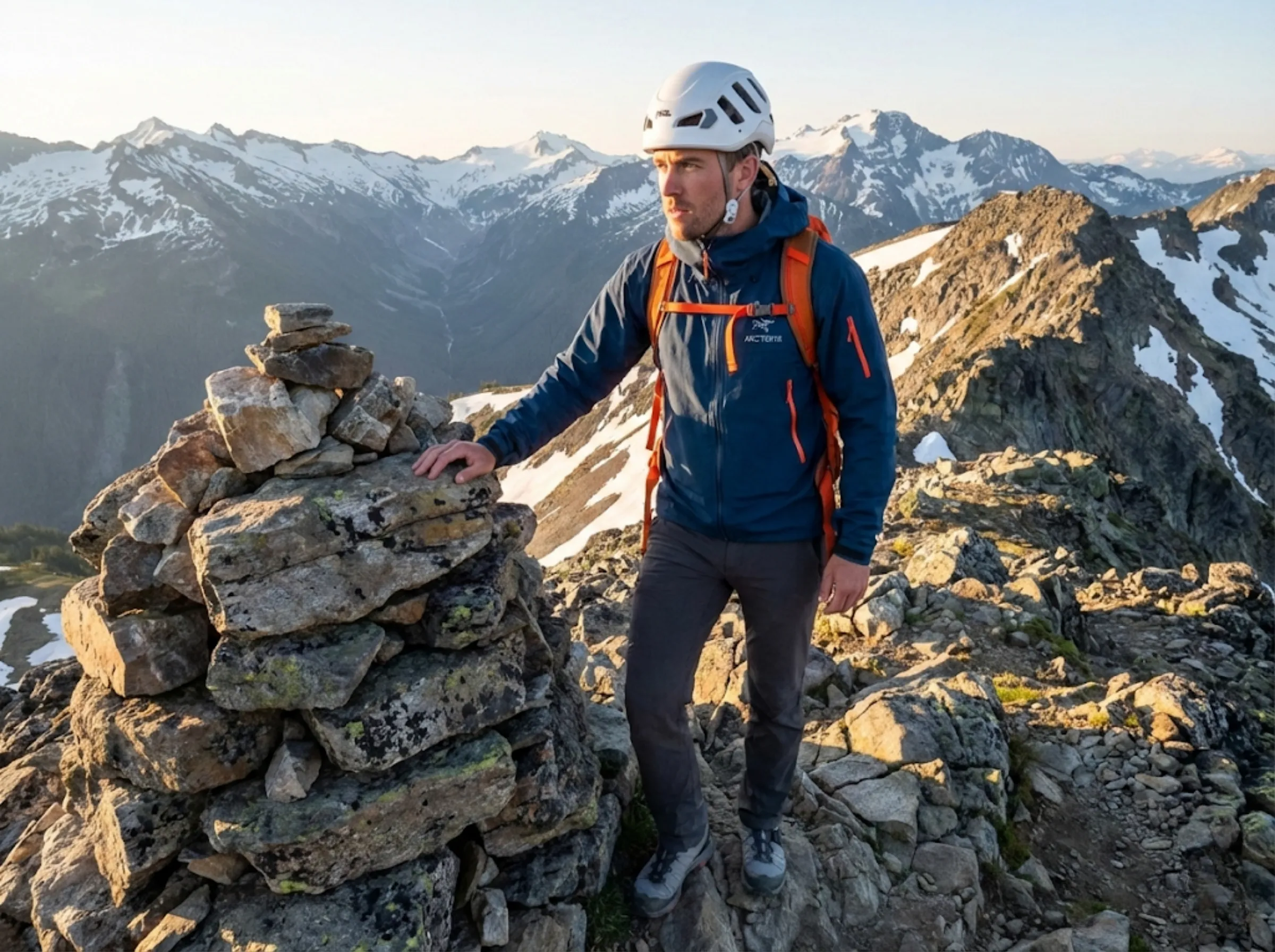
A properly built rock cairn is engineering disguised as a pile of rocks. Official cairns stand 3 to 5 feet tall in treeless zones where soil won’t hold signage. They’re constructed with overlapping rocks, each stone touching at least three points for stability, the whole structure sloping inward like a cone.
In Acadia National Park, the Bates Cairn is even more precise: two base stones, a lintel across the top, and a pointer rock indicating direction. These aren’t art projects. They’re designed to stay visible in driving rain, thick fog, and whiteout conditions where you can’t see 20 feet ahead.
If you spot a cairn that looks like it would topple in a stiff wind—a single column of rocks balanced on top of each other—you’re looking at a social trail marker, not a navigational aid. Keep moving.
Painted Bull’s-Eyes and Trail Blazes
In forested Class 1 and 2 terrain, standard trail blazes are 2-inch by 6-inch vertical rectangles painted on trees. Simple, effective, easy to spot.
High-alpine Class 3 zones demand something more visible. On Longs Peak, the NPS uses distinct red and yellow paint bull’s-eyes painted directly onto rock faces. These markers delimit the boundary between manageable scrambling and lethal exposure. They’re repainted every 5 to 8 years, and in between, they fade. Old routes sometimes show only a ghost of color—enough to see if you know what you’re looking for, invisible if you don’t.
The official NPS guidance is unambiguous: follow the bull’s-eyes, period. If you haven’t seen one in several minutes, stop. You’re not lost yet, but you’re about to be.
Social Cairns and “Ducks”: The Misleading Markers
Here’s the problem: well-meaning hikers build their own cairns. These social cairns or “ducks” are small, unstable, and often mark nothing more than “I was here.” They violate Leave No Trace principles, disturb habitats, and—worst of all—create false leads that can walk you right off a cliff.
Yosemite National Park Rangers put it bluntly: “Building rock cairns disturbs small insects, reptiles, and microorganisms that call the underside home.” In some parks, rangers knock them down on sight. In the meantime, you need to know the difference.
If a cairn looks like an art installation instead of a navigation tool, ignore it.
Flagging Tape, Mining Posts, and Other False Friends
Bright plastic flagging tape tied to trees and rocks catches the eye. Most hikers assume it marks a trail. It doesn’t.
Surveying tape typically marks forestry boundaries, timber sales, or mining surveys. The colors aren’t standardized—orange might mark a property line in one forest and a Nordic ski route in another. Following it as if it were a hiking trail will send you cross-country into terrain that has nothing to do with your destination.
Even more confusing are mining claim markers: 4×4 wooden posts or PVC pipes marking the corners of claims established under the 1872 Mining Law. These posts form a grid across the landscape, completely unrelated to topography or safe passage. Following them is like walking a property line—which might traverse sheer cliffs, dense brush, or worse.
Rule of thumb: if you don’t recognize it as an official trail marker, assume it isn’t one.
Reading Markers in the Field: The Longs Peak Case Study
Theory only gets you so far. Let’s walk through the most famous Class 3 route in Colorado—the Keyhole Route on Longs Peak—and see how marker reading works in practice.
The Keyhole: Where Class 3 Begins
At 13,200 feet, you pass through a geological notch called the Keyhole. Wind screams through this gap. Behind you is Boulder Field—Class 2, straightforward. Ahead is the back of the mountain—Class 3, consequential.
This is the psychological threshold where roughly half of Longs Peak attempts end. Hikers look at the Ledges ahead, feel the exposure, and turn around. Those who continue commit to trusting the paint absolutely.
From the Keyhole forward, your intuition becomes your enemy. Trust the bull’s-eye markers. Not the path of least resistance. Not what looks easiest. The paint.
If you’re not yet equipped with essential gear for alpine scrambling, the Keyhole is a good place to turn back and get ready.
The Ledges: When Markers Defy Logic
The Ledges are narrow traverses along cliff edges. A slip here is usually fatal.
Here’s what gets people: the route doesn’t always go up. At one point, you climb 50 feet, then descend 100 feet. Your brain screams that you’re going the wrong direction—the summit is UP, not down. But the bull’s-eyes lead down, and the bull’s-eyes are right.
This is where marker reading becomes an exercise in overriding instinct. The paint knows. You don’t. Follow it.
Pro tip: Count markers to stay oriented. If you go three minutes without seeing a bull’s-eye, stop immediately and backtrack until you find the last one.
The Trough: Markers in Chaos
The Trough is 600 feet of steep loose-rock gully. Rockfall risk is real—this is where a scrambling helmet from Petzl or Black Diamond earns its keep.
Stay central in the gully. The edges are looser and more dangerous. Markers here are harder to spot amid the rubble, and your GPS may be lying to you. In couloirs like this, satellite signals bounce off the rock walls, creating multipath errors that can show your location 50 to 100 feet from reality.
Visual navigation aids take precedence over digital data. Eyes first, screen second.
The Narrows and Homestretch: Endgame Navigation
The Narrows are highly exposed ledges where slips are fatal. The Homestretch is 800 feet of polished granite slabs—slick when wet, demanding hand-over-hand technique even when dry.
Fatigue is maximum here, but marker vigilance cannot drop. The route continues to be marked, and the summit is close enough to taste.
One more essential habit: before you summit, turn around and memorize the view. The descent looks nothing like the ascent. What was obvious going up vanishes into visual chaos going down.
When Markers Fail: Building True Route-Finding Independence
Every guide teaches you to follow the markers. Almost none teach you what to do when the markers disappear. This is the gap that gets hikers rescued—or worse.
Snow, Fog, and Fading: Conditions That Hide Your Lifeline
Snow buries painted markers and small cairns completely. Fog reduces visibility to feet. Rain changes rock coloration, making faded bull’s-eyes invisible against wet granite. Dawn and dusk light—headlamp illumination—reveals markers differently than midday sun.
If conditions deteriorate, slow down radically. In fog, move marker-to-marker only—do not proceed until you’ve visually confirmed the next one. If you can’t see it, you don’t move.
The Lichen Line: Reading the Rock Itself
When all else fails, the rock talks to you—if you know how to listen.
On popular granite routes, thousands of boots have polished the “official” path clean. The trail shows up as lighter, lichen-free rock. Off-route terrain remains darker, crusted with lichen.
Learning to read these lichen lines is an advanced skill, but it works when nothing else does. The path is in the rock, whether anyone painted it or not.
For those developing analog navigation skills, this is the kind of old-school technique that separates scramblers who always find their way from those who sometimes don’t.
The “Look Back” Protocol
The research is clear: descents cause twice as many rescues as ascents. The route you followed up becomes unrecognizable from above. Drop-offs hide the path. Fatigue clouds judgment.
Solution: during your ascent, stop regularly and look back. Memorize what you’ll see on the way down. Take photos at key decision points. When you’re exhausted and the mountain looks foreign, those mental snapshots—and those phone photos—will bring you home.
Pro tip: Every time you pass a major turn or junction, stop, face downhill, and take a photo. That 3-second habit could save your trip.
Essential Gear for Class 3 Marker Navigation
The right equipment won’t make you a better route-finder—but the wrong equipment can make good route-finding irrelevant.
Scrambling Helmets: Non-Negotiable Protection
Channeled terrain like the Trough funnels rockfall straight at your head. A climbing helmet isn’t optional gear—it’s the price of admission.
The Petzl Sirocco is ultralight for speed-focused scramblers. The Black Diamond Vision trades a few ounces for durability. Either works. Neither costs more than $150, and both cost less than a skull fracture.
Look for MIPS technology if you want additional protection against rotational forces. And if you’re building a complete scrambling gear checklist, start with the helmet. Everything else is negotiable until your first rock comes bouncing down the couloir.
GPS and Mapping: Backup, Not Primary
A quality GPS device like the Garmin GPSMAP 67i offers satellite communication and automatic track logging. But in Class 3 terrain—especially in deep couloirs—GPS accuracy degrades. Multipath errors bounce your position across the screen.
The NPS is explicit: “GPS can be useful as a backup but should not be your primary means of navigation.” Record your ascent track for retracing on descent. But keep your eyes on the rock, not the screen.
Carry a paper topographic map and a compass as your ultimate backup. Batteries die. Satellites lose signal. Paper and magnetic north don’t fail.
If you’re evaluating options, check out choosing the right hiking GPS app to understand what digital navigation tools can and can’t do for you.
Conclusion
Three things will get you home from Class 3 terrain:
- Know your markers. Red-and-yellow bull’s-eyes on Longs Peak, official cairns built like pyramids—these are non-negotiable navigation aids. Social trails, flagging tape, mining posts? Ignore them.
- Develop marker independence. The scramblers who consistently summit don’t just follow paint. They read lichen lines, memorize descent views, and know what to do when the markers vanish.
- Respect the descent. Your trip is only halfway done at the summit. Twice as many rescues happen going down. Stay vigilant until you’re below the Keyhole.
The next time you cross a threshold like the Keyhole, pause. Look at the bull’s-eye ahead. Then turn around and memorize what you’ll see on the way back. That three-second habit is the difference between hikers who tell great stories and hikers who become the story.
FAQ
What is Class 3 scrambling and is it dangerous?
Class 3 scrambling is steep, rocky terrain requiring handholds for upward movement—hands for safety, not just balance. A fall can cause serious injury or death, though the terrain offers abundant natural holds. It’s the transition zone where hiking ends and technical climbing begins.
What do the red and yellow bull’s-eye markers mean on Longs Peak?
These painted bull’s-eyes mark the only safe route through the Keyhole Route’s technical sections. The NPS states that losing sight of them means you are off-route and will face more difficult climbing with severe consequences. They’re literally a life-or-death visual guide.
Can I rely on my GPS for Class 3 route-finding?
GPS should be a backup, not your primary navigation. In steep terrain like the Trough, signals bounce off rock walls and show your position up to 100 feet from reality. Visual navigation aids must take precedence over digital data.
How do I know if a cairn is an official trail marker or just rocks stacked by hikers?
Official rock cairns are 3-5 feet tall, built with interlocking rocks for stability. Social cairns are typically small, precarious stacks that would topple in a stiff wind. When in doubt, don’t follow it.
What should I do if I lose the trail markers in fog or snow?
Stop immediately. Do not proceed without visual confirmation of the next marker. In fog, move marker-to-marker only. In snow, look for the lichen-free path polished by thousands of boots. If truly lost, retrace your confirmed route rather than guessing forward.
Risk Disclaimer: Hiking, trekking, backpacking, and all related outdoor activities involve inherent risks which may result in serious injury, illness, or death. The information provided on The Hiking Tribe is for educational and informational purposes only. While we strive for accuracy, information on trails, gear, techniques, and safety is not a substitute for your own best judgment and thorough preparation. Trail conditions, weather, and other environmental factors change rapidly and may differ from what is described on this site. Always check with official sources like park services for the most current alerts and conditions. Never undertake a hike beyond your abilities and always be prepared for the unexpected. By using this website, you agree that you are solely responsible for your own safety. Any reliance you place on our content is strictly at your own risk, and you assume all liability for your actions and decisions in the outdoors. The Hiking Tribe and its authors will not be held liable for any injury, damage, or loss sustained in connection with the use of the information herein.
Affiliate Disclosure: We are a participant in the Amazon Services LLC Associates Program, an affiliate advertising program designed to provide a means for us to earn advertising fees by advertising and linking to Amazon.com. As an Amazon Associate, we earn from qualifying purchases. We also participate in other affiliate programs and may receive a commission on products purchased through our links, at no extra cost to you. Additional terms are found in the terms of service.

