In this article
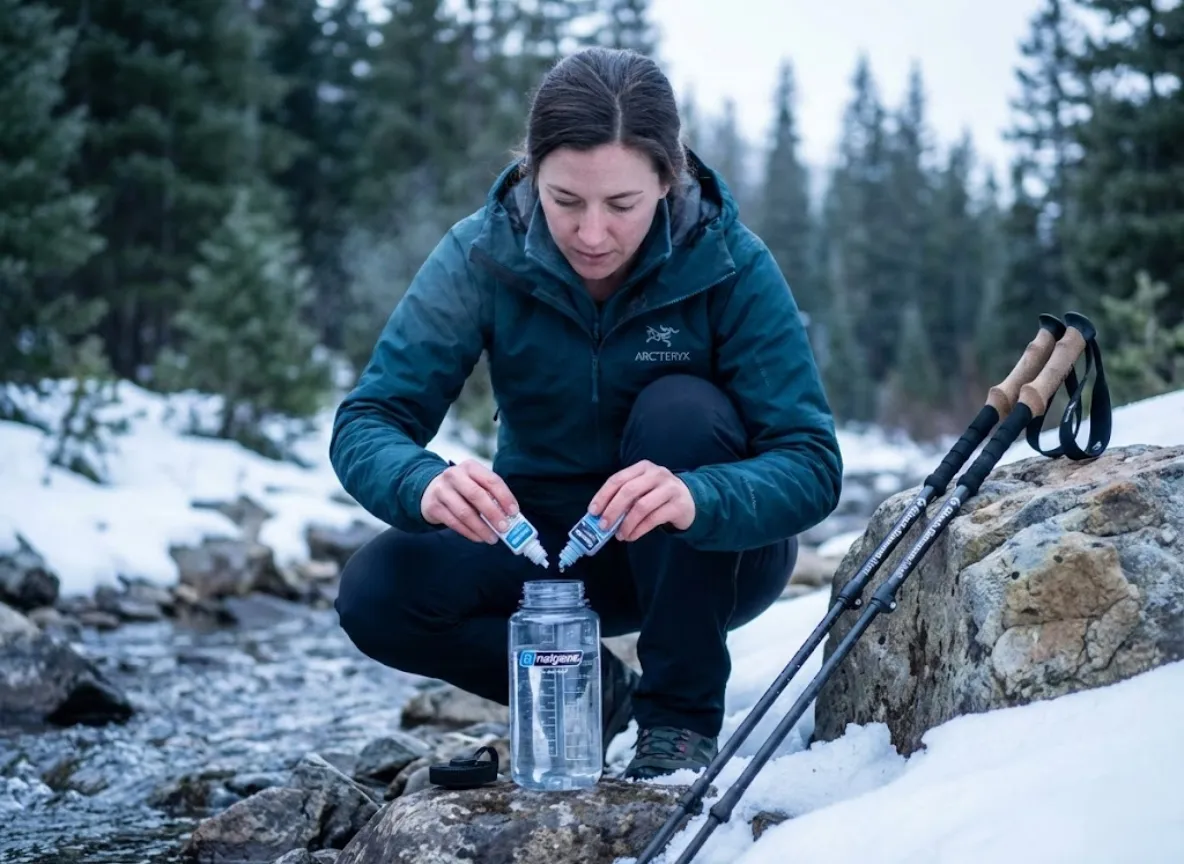
It’s 6 AM on a February morning in the Rockies. Your Sawyer Squeeze froze solid overnight—you forgot to tuck it into your sleeping bag. You dump Aquamira drops into meltwater that’s barely above freezing, count to fifteen minutes like the package says, and drink. Three days later, you’re doubled over with cramps in a high hut, wondering what went wrong.
The answer is thermodynamics. And most hikers have never seen the real numbers.
After years of winter backpacking and more than a few close calls with backcountry water purification, I’ve learned that the instructions on your treatment bottle are written for room-temperature lab conditions—not February snowmelt. Here’s exactly what happens when cold water meets your chemical treatment, and the adjusted dwell times you actually need to stay healthy.
⚡ Quick Answer: Chemical water treatment slows dramatically in cold water. At temperatures below 5°C (40°F), you should at minimum double standard treatment times: 30+ minutes for bacteria instead of 15, and potentially 6+ hours for Cryptosporidium instead of 4 hours. Iodine tablets are completely ineffective against Crypto regardless of wait time. Always keep filters warm to prevent invisible freeze damage.
The Science Behind the Wait: Why Cold Slows Everything

Every hiker knows the rule: cold water means longer wait times. But few understand why—or by how much. The physics here aren’t optional, and they’re unforgiving.
The Arrhenius Equation in Your Water Bottle
Chemical disinfection is a contact sport at the molecular level. The disinfectant molecule—whether Chlorine Dioxide or iodine—must physically collide with a pathogen’s cell wall and hit it with enough energy to break through. When water temperature drops, those molecules move slower and strike with less force.
The relationship isn’t linear. As temperature drops from 20°C to near-freezing, chemical reaction rates don’t just decrease—they plummet. This is why the “wait a little longer” advice is dangerously vague.
According to EPA disinfection profiling and benchmarking guidance, reducing water temperatures from 20°C to 10°C can cut disinfection effectiveness by 40 percent. Drop to near-freezing, and you’re looking at treatment times that multiply several times over.
Pro tip: I carry a small thermometer strip stuck to my water bottle. Knowing the actual temp lets me calculate rather than hope. When your water is truly cold, you need real data—not guesswork.
CT Values: The Math Behind Safe Water
The EPA uses something called a CT value—Concentration times Time—to measure disinfection. For Cryptosporidium at room temperature, you need roughly 232 mg·min/L for 99% kill rate. At 0.5°C? That jumps to 1275 mg·min/L. That’s a 5.5-fold increase in required treatment.
What does this mean in your bottle? If Aquamira provides about 4 parts per million concentration, the numbers work out to over 5 hours of contact time for complete Crypto protection in near-freezing water. The 4-hour rule on the package assumes warmer conditions than you’ll find in February snowmelt.
Why the Package Instructions Aren’t Enough
Manufacturers write their instructions for standard conditions—typically 20-25°C water with moderate clarity. They’re not trying to mislead you; they just can’t print a different label for every possible scenario.
The gap between room-temperature lab results and cold-weather water treatment reality is exactly where waterborne illness happens. Most hikers who get sick in winter simply didn’t wait long enough.
The Pathogen Hierarchy: Not All Bugs Are Equal
The reason treatment times vary so dramatically comes down to what you’re trying to kill. Some pathogens fold quickly. Others are armored against chemical attack.
Bacteria and Viruses: The Easy Kills
Bacteria like E. coli and viruses like Rotavirus have relatively fragile membranes. Chlorine Dioxide destroys them within 15-30 minutes even in moderately cold water. These are the pathogens most filters and treatments handle easily—even in colder water temperatures.
That said, never shortcut the wait just because bacteria die fast. You don’t know what’s actually in the water until symptoms hit days later.
Giardia: The Middle Ground
Giardia lamblia forms protective cysts that resist chemical oxidation 2-5 times better than bacteria. At 10°C, iodine achieves only 90% inactivation in 30 minutes—which means one in ten cysts survives. That’s enough to ruin your trip.
According to US Army iodine disinfection technical guidance, extending iodine contact time to over 90 minutes in water below 5°C is recommended for adequate Giardia protection. Chlorine Dioxide handles it more reliably—60 minutes in cold water provides solid defense.
Cryptosporidium: The Protocol Driver
Cryptosporidium oocysts are encased in a thick shell that resists chemical attack. They’re 8-16 times more resistant than Giardia, and they’re the reason the 4-hour rule exists.
Here’s the critical fact most hikers miss: iodine is completely ineffective against Cryptosporidium—regardless of concentration, dwell time, or temperature. The CDC, EPA, and U.S. Army all confirm this. It’s not a matter of waiting longer. The chemistry simply doesn’t work.
Where does Crypto hide? Cattle grazing areas, popular trails with high human traffic, water downstream from campgrounds. Snowmelt isn’t sterile either—animals walk on that snow all winter.
Pro tip: If you’re using iodine tablets in cattle country or on high-traffic trails, you’re gambling. Crypto doesn’t care how patient you are.
Treatment Methods Compared: What Actually Works in Winter
Not all water treatment systems perform equally when temperatures drop. Some handle winter conditions reliably. Others become liabilities.
Chlorine Dioxide (Aquamira, Micropur): The Winter Standard
Chlorine Dioxide works as a dissolved gas that oxidizes cell walls without hydrolyzing like chlorine. This makes it effective across a wider pH range—important in alkaline mountain streams where regular bleach struggles.
Aquamira drops and Katadyn Micropur tablets share a major cold-weather advantage: they’re freeze-thaw stable. If your treatment bottles freeze in your pack, they retain full potency after thawing. Just shake well.
For water below 5°C, adjust your expectations:
- Bacteria and viruses: 30 minutes (vs. 15 standard)
- Giardia cysts: 60 minutes (vs. 30 standard)
- Cryptosporidium: 6+ hours (vs. 4 standard)
The premix activation step matters too. Mixing Part A and Part B releases active ClO₂—but that reaction also slows in cold air. Extend the premix wait from 5 minutes to 10 when temperatures drop below freezing.
Iodine (Potable Aqua): The Cold-Weather Liability
Potable Aqua tablets release 8 ppm of titratable iodine—but their dissolution rate drops significantly in cold water. Less available iodine means weaker disinfection during those critical first minutes.
You must double treatment time below 40°F (4°C). And even then, you’re not protected against Cryptosporidium. Ever. The U.S. Army explicitly states that Crypto inactivation is “not practical” with iodine solutions.
When does iodine make sense? Short trips in areas with known low Crypto risk, treating clean water from fast-moving streams above grazing zones. Otherwise, stick with ClO₂.
Boiling: The Bombproof Backup
Boiling provides instant, 100% effective disinfection against all pathogens including Crypto. Thermal inactivation happens rapidly above 149°F—well below boiling point at any altitude.
The altitude myth needs to die: you do NOT need to boil longer at elevation. A rolling boil at 10,000 feet (roughly 193°F) still works perfectly. Pathogens die from heat, not the bubbles.
The limitation is fuel weight. Melting snow and then boiling can eat 10-15 minutes of stove time per liter. A hybrid strategy works well: boil camp water for dinner and breakfast, use chemical treatment for on-the-go hydration with body-heat warming.
Filters in Winter: The Freeze Risk Reality
Hollow fiber filters like the Sawyer Squeeze and Platypus QuickDraw use microscopic straw-like fibers with 0.1-micron pores. When water inside freezes, ice expands by 9%—cracking those fibers invisibly.
A freeze-damaged filter shows no visible signs of failure. It may actually flow faster because cracks bypass the filter medium entirely. The only reliable water treatment check is the manufacturer-approved integrity test: push air through a fully wetted filter. Continuous bubbles mean broken fibers. The “blue dye test” is unreliable—dye particles often pass through intact filters.
Prevention is simple: sleep with your filter. Keep it in your sleeping bag, inside your jacket, or in an insulated pouch. Never leave it exposed to freezing temperatures overnight.
Pro tip: If you’re unsure whether your filter froze, treat it as compromised and rely on chemical backup. Filter freeze damage is invisible, but the consequences aren’t.
Field Protocols: Making Cold Treatment Work
Understanding the science is half the battle. Putting it into practice requires specific techniques that experienced winter backpacking hikers rely on.
The Body Heat Reactor Method
If cold water extends reaction times, warming the water shortens them. Your body provides a reliable heat source.
After adding treatment, tuck the bottle inside your jacket—between your base layer and mid-layer. You can also slip it under your quilt while hiking with a hip belt, or against your core in your sleeping bag.
Warming water from near-freezing to 15-20°C can cut your wait time roughly in half. I treat water at lunch, tuck it inside my puffy, and have safe water by dinner without the 6-hour stove-side wait.
This technique integrates perfectly with your winter layering system—you’re already generating heat, so put it to work.
The Upside-Down Storage Trick
Water freezes from the top down, and ice floats. Store a bottle right-side up, and ice seals the cap threads—making it impossible to open without thawing first.
Store bottles upside down. Ice forms at the base (now the bottom), leaving the lid threads clear and accessible. This simple flip saved me on the AT in January—without it, I’d have been chipping ice off bottle threads with frozen fingers every morning.
Warning: ensure your lids seal completely. A leak in your sleeping bag creates a cold, wet disaster.
Managing Turbidity: The Glacial Flour Problem
Glacial flour—fine rock silt in meltwater—creates high turbidity that sabotages treatment. Suspended particles physically shield pathogens from disinfectant contact and consume oxidizer before it reaches the bugs.
In visibly cloudy water, double your dosage OR double your wait time. For heavily turbid sources, let the bottle sit for 30 minutes first, then decant the clearer water into a second container for treatment.
A tightly woven bandana removes the largest particles but cannot substitute for proper treatment.
The pH Factor Most Hikers Miss
High-altitude limestone environments—parts of the Rockies and Alps—produce alkaline water with pH above 8.0. This matters more than most hikers realize.
At high pH, chlorine shifts from Hypochlorous Acid (strong disinfectant) to Hypochlorite Ion (weak disinfectant). Chemical efficacy drops dramatically. Chlorine Dioxide doesn’t have this problem—it functions as a dissolved gas with stable performance between pH 6-9.
In alkaline mountain streams, ClO₂ outperforms iodine and bleach even more dramatically than in neutral water.
Critical Mistakes That Get Hikers Sick
Knowing the protocols isn’t enough if you fall into common traps. These mistakes account for most cold-weather treatment failures.
Rushing the Wait Time
Cold and thirsty hikers rationalize. Fifteen minutes feels like enough. But chemical reaction times don’t care about your discomfort.
Waterborne illness symptoms often appear 3-7 days after exposure. By then, you’ve forgotten which water source caused the problem. Giardiasis means 1-3 weeks of debilitating symptoms. Cryptosporidiosis has no specific treatment—only supportive care.
Set a timer. Don’t rely on intuition when thermodynamics is working against you.
Trusting a Frozen Filter
“It still flows water, so it must be fine” is the freeze-thaw damage fallacy. Cracked fibers flow faster than intact ones because the cracks bypass the filtration medium.
The only reliable check is the air bubble integrity test. If you can’t test it, assume it’s compromised. Sleeping with your filter is far easier than diagnosing invisible damage.
For newer hikers building their backpacking gear system, understand that filter care is non-negotiable in winter. One freezing night can destroy a $40 investment—or worse, make you sick.
Relying on Iodine in Crypto Country
The “wait longer” myth leads hikers to believe any chemical works with enough patience. For Cryptosporidium, that’s false. Iodine’s mechanism cannot penetrate the oocyst wall regardless of concentration or time.
High-risk areas include cattle grazing zones, popular trails with heavy human traffic, and water downstream from established campsites. In these environments, use Chlorine Dioxide or boiling—never iodine alone.
Ignoring the Melt-Contamination Problem
Adding treatment to water containing ice chunks creates a contamination window. As ice melts after treatment, it releases untreated water into your “safe” container.
Melt all snow and ice completely before treating. No ice chunks in your treatment vessel. When melting snow, start with a small amount of liquid water in the pot to prevent scorching—the sublimation gap between pot and snow wastes fuel and time.
Conclusion
Cold water treatment isn’t mysterious—it’s thermodynamics. Chemical reaction rates drop as temperature drops, and the math demands longer wait times. For water approaching freezing, standard 15-minute Chlorine Dioxide treatment becomes 30+ minutes for bacteria and potentially 6+ hours for Cryptosporidium. Iodine fails completely against Crypto at any temperature. Frozen filters lie about their integrity.
Three takeaways to live by: First, know your multiplier—in water below 5°C, at minimum double all manufacturer wait times. Second, choose the right tool—Chlorine Dioxide is the only viable chemical for winter Crypto protection. Third, protect your failsafes—sleep with your filter, warm your treatment water, and always carry backup chemicals.
Your next cold-weather trip is a chance to practice this system before it becomes critical. Treat camp water with intentional timing, run an integrity test on your filter, and experience the discipline of patience. The stakes are your health—and knowing the real numbers puts you ahead of most hikers on the trail.
FAQ
Do water purification tablets work in cold weather?
Yes, but they work much slower. Chlorine Dioxide tablets like Katadyn Micropur remain effective in cold water, but contact time must be extended—roughly doubled below 40°F (4°C), and potentially 6+ hours for full Cryptosporidium protection in near-freezing conditions. Iodine tablets are completely ineffective against Crypto regardless of temperature.
How long does Aquamira take in cold water?
In water below 5°C (41°F), expect 30 minutes for bacteria and viruses (vs. 15 standard), 60 minutes for Giardia (vs. 30 standard), and 6+ hours for Cryptosporidium (vs. 4 hours). The colder the water, the longer the chemistry takes.
Can you use a Sawyer filter in freezing temperatures?
You can, but with extreme caution. Water freezing inside hollow fiber filters causes invisible damage that compromises filtration. Always keep filters warm—in your sleeping bag or against your body—and perform an air bubble integrity test after any suspected freeze event. If uncertain, treat the filter as compromised.
Does iodine kill Cryptosporidium?
No. Iodine is completely ineffective against Cryptosporidium oocysts regardless of concentration, dwell time, or temperature. The CDC, EPA, and U.S. Army all confirm this limitation. In areas with potential Crypto contamination, use Chlorine Dioxide or boiling instead.
Is boiling water less effective at high altitude?
No. Although water boils at lower temperatures at altitude (approximately 193°F at 10,000 ft), this is still far above the thermal death threshold for pathogens (~150°F). A rolling boil at any altitude provides instant, 100% effective disinfection against all pathogens including Cryptosporidium.
Risk Disclaimer: Hiking, trekking, backpacking, and all related outdoor activities involve inherent risks which may result in serious injury, illness, or death. The information provided on The Hiking Tribe is for educational and informational purposes only. While we strive for accuracy, information on trails, gear, techniques, and safety is not a substitute for your own best judgment and thorough preparation. Trail conditions, weather, and other environmental factors change rapidly and may differ from what is described on this site. Always check with official sources like park services for the most current alerts and conditions. Never undertake a hike beyond your abilities and always be prepared for the unexpected. By using this website, you agree that you are solely responsible for your own safety. Any reliance you place on our content is strictly at your own risk, and you assume all liability for your actions and decisions in the outdoors. The Hiking Tribe and its authors will not be held liable for any injury, damage, or loss sustained in connection with the use of the information herein.
Affiliate Disclosure: We are a participant in the Amazon Services LLC Associates Program, an affiliate advertising program designed to provide a means for us to earn advertising fees by advertising and linking to Amazon.com. As an Amazon Associate, we earn from qualifying purchases. We also participate in other affiliate programs and may receive a commission on products purchased through our links, at no extra cost to you. Additional terms are found in the terms of service.