In this article
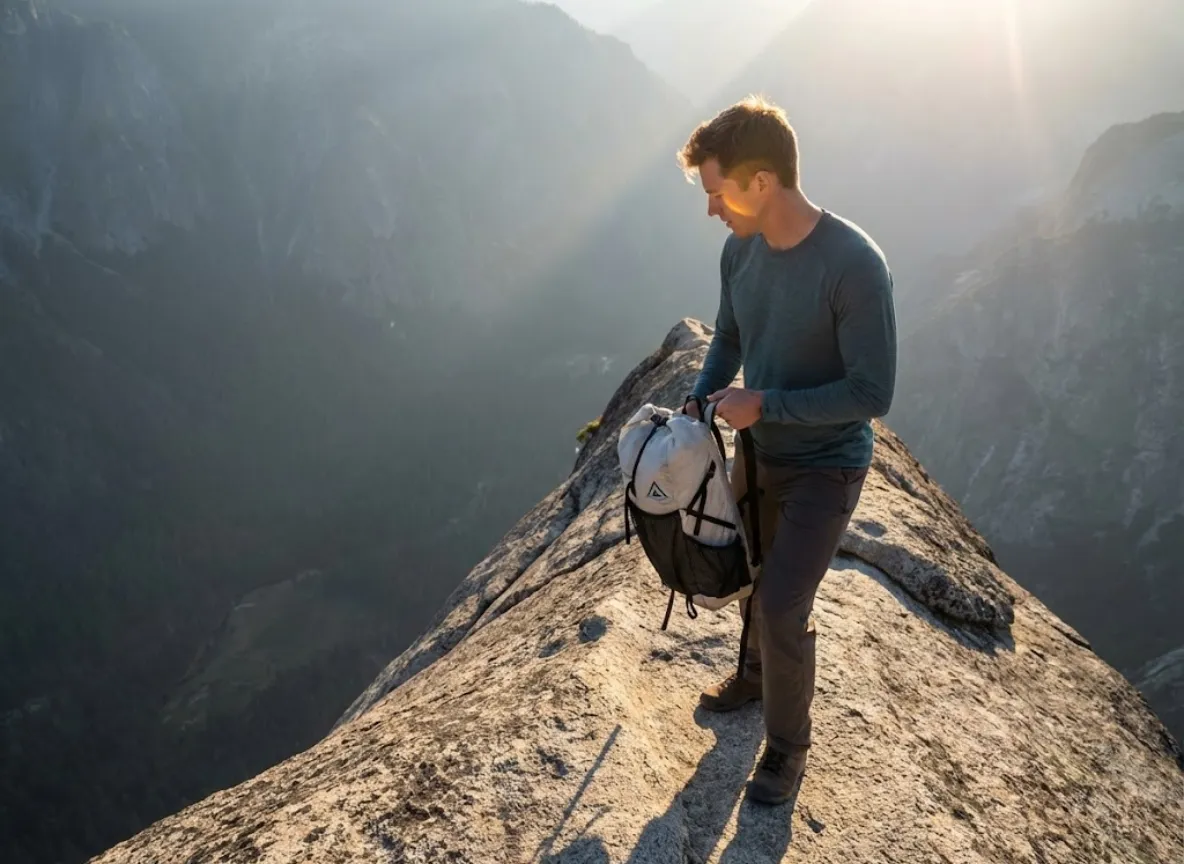
The map labels the route “Class 4,” but the rock under your hand is vibrating loose shale. The drop below your heels is two thousand feet of empty air. At this altitude, a number grade is no longer data; it is a direct measurement of consequence.
For the transitional hiker—fit, ambitious, but untrained in technical alpinism—misinterpreting the Yosemite Decimal System (YDS) is the most common precursor to a rescue. I have spent years teaching outdoor education, and I have seen confident hikers freeze on terrain that looked benign in a guidebook.
This guide strips away the climber’s jargon to reveal the friction, exposure, and biomechanics hidden behind the numbers. We aren’t just reading a scale; we are translating the hiker’s risk matrix into a tangible survival instinct to bridge the dangerous gap between walking and climbing.
What is the Yosemite Decimal System and why does it fail the modern hiker?
The YDS was developed by the Sierra Club in the 1930s, refined at climbing proving grounds like Tahquitz Peak and Suicide Rocks, to categorize technical rock climbing routes in the Sierra Nevada. It was never intended to be a safety map for hikers.
How did a climber’s technical scale become a hiker’s survival map?
The system was originally designed to describe the single hardest move on a route, known as the crux. This creates a grading system that focuses on momentary difficulty rather than sustained risk. For the average hiker, the distinctions between technical decimal digits are irrelevant. The only transition that matters is the biomechanical shift from Class 1 (walking) to Class 3 (scrambling).
A critical flaw for hikers is that YDS ratings historically ignore the “consequence of fall.” A move five feet off the ground and five hundred feet up can share the same Yosemite number. As you begin elevating your hiking passion into non-technical mountaineering, understanding this disconnect becomes vital. The rating measures technicality, not necessarily danger or fatality risk.
Subjectivity is also rampant. Ratings are often consensus-based, meaning a “Sandbagged” (underrated) route established by a tall, skilled climber can trap a shorter, less experienced hiker. While the USDA Forest Service: Climbing and Mountaineering Safety outlines these categories broadly, the nuance is often lost in translation. Modern guidebooks may append protection ratings (like G, PG-13, R, or the dreaded X) to warn of runout danger, but these are often absent on hiking maps.
What are the “Survival Stakes” of the five YDS classes?
Class 1 & 2 (Locomotion): Here, risk is physiological, stemming from exhaustion or weather. Movement is entirely leg-driven on trail conditions ranging from packed dirt to scree. Your hands are used only for balance or holding trekking poles.
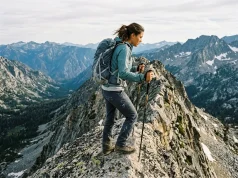
Class 3 (The No-Fall Zone): Movement shifts to three-points-of-contact (hands and feet). A fall here results in broken bones or severe trauma. Simple scrambling is required. This is the first major threshold. According to Princeton University Outdoor Action: Climbing & Scrambling Ratings, this is where the line blurs between hiking and climbing.
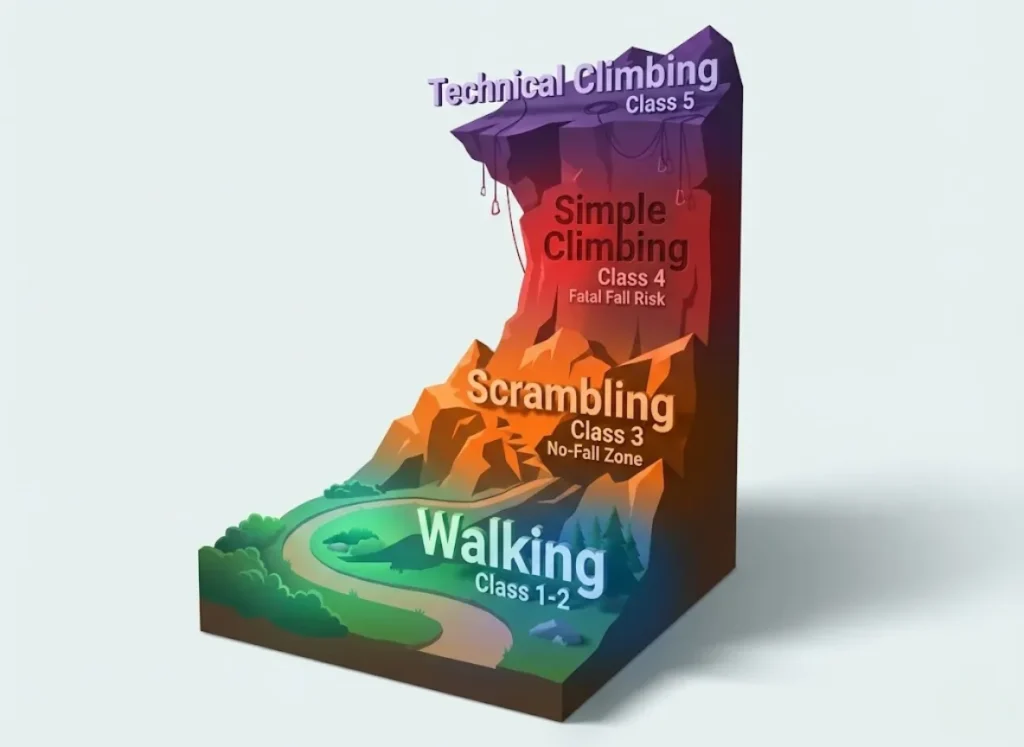
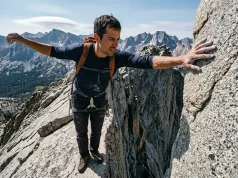
Class 4 (The Death Zone): Movement is vertical. Holds are smaller. A fall without a rope is almost certainly fatal. This is the absolute limit for an unroped hiker.
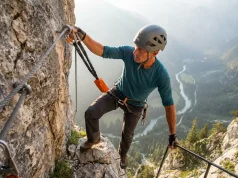
Class 5 (Technical Climbing): Gravity dictates that any fall is fatal. Dynamic rope, harness, belay device, and protection hardware (cams, nuts) are mandatory for survival. The decimal point was added here in the 1950s (initially by Royal Robbins and the Sierra crew) to subdivide difficulty, ranging from 5.0 up to the futuristic 5.15d established by climbers like Adam Ondra on routes like Silence or The Dawn Wall.
The transition from Class 2 to 3 is not linear; it is a step-function change in cognitive load. You must stop understanding terrain classifications (Class 3 & 4) as abstract grade numbers and start seeing them as requirements for focus and friction.
Where is the line between a scramble and a solo climb?
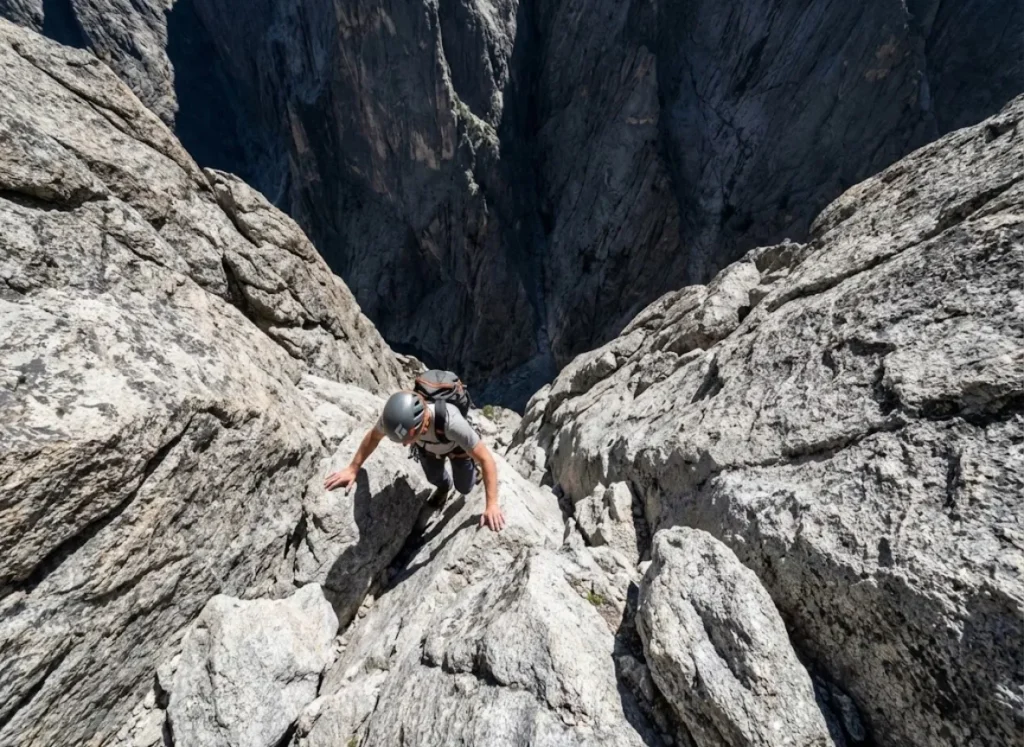
The hiker’s grey area between Class 3 and Class 4 is the most frequent site of hiker accidents. It is where confidence often outpaces competence on the scramble-o-meter.
What defines Class 3 terrain and the “No-Fall Zone”?
Class 3 is characterized by scrambling where handholds are abundant and footholds are large, but the consequence of a slip changes from a scraped knee to a broken bone. The three-points-of-contact rule becomes mandatory here. You are no longer walking; you are climbing using your hands for upward propulsion.
The term “No-Fall Zone” applies because while the climbing feels easy, the terrain below is often unforgiving. A slide on a Class 3 slab accelerates quickly. As noted by the National Park Service: Grand Teton Climbing & Mountaineering, proficiency in this terrain is a prerequisite for high peaks.
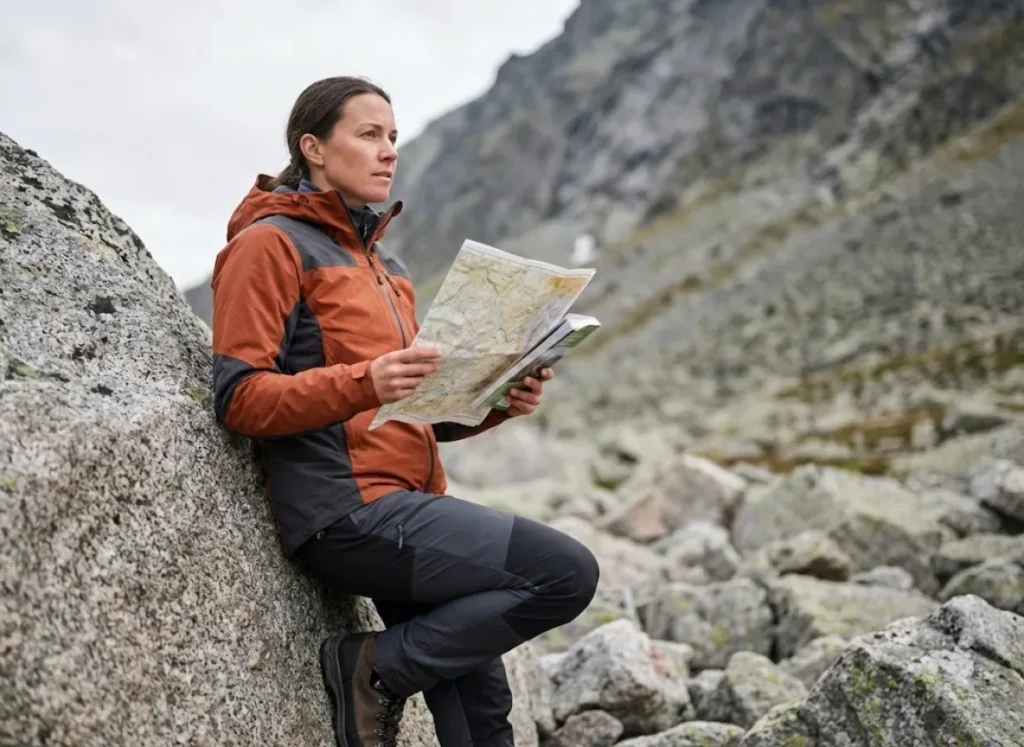
Route finding errors are the primary hazard. Drifting off-trail often leads a hiker unknowingly into Class 4 or 5 terrain (“cliffing out”). This is a critical moment for preventing panic when lost or stuck. You generally cannot descend what you just barely ascended.
Pro-Tip: If you have to jump or lunge to reach a hold, you are off-route. Class 3 movement should be static and controlled. If it feels dynamic, back off and look for the correct line.
Why is Class 4 considered the “Death Zone” for hikers?
Class 4 represents a fundamental breach of the safety contract. The terrain is steep to vertical rock, holds may be smaller or sparse, and a fall is almost universally fatal.
The “Rope Fallacy” is dangerous here. Guidebooks often state “rope often used,” confusing hikers who lack belay skills into thinking they can attempt it without one. This effectively means they are free-soloing. The American Alpine Club: Accidents in North American Climbing data confirms that unroped scrambles in this terrain are a leading cause of fatalities.
Down-climbing Class 4 is significantly harder than ascending. Hikers often scramble up adrenaline-fueled moves only to find themselves trapped, unable to reverse the sequence. This is why investing in non-negotiable gear for alpine scrambling, such as a helmet and proper footwear, is not optional—it is life support.
How do iconic North American peaks calibrate to these ratings?
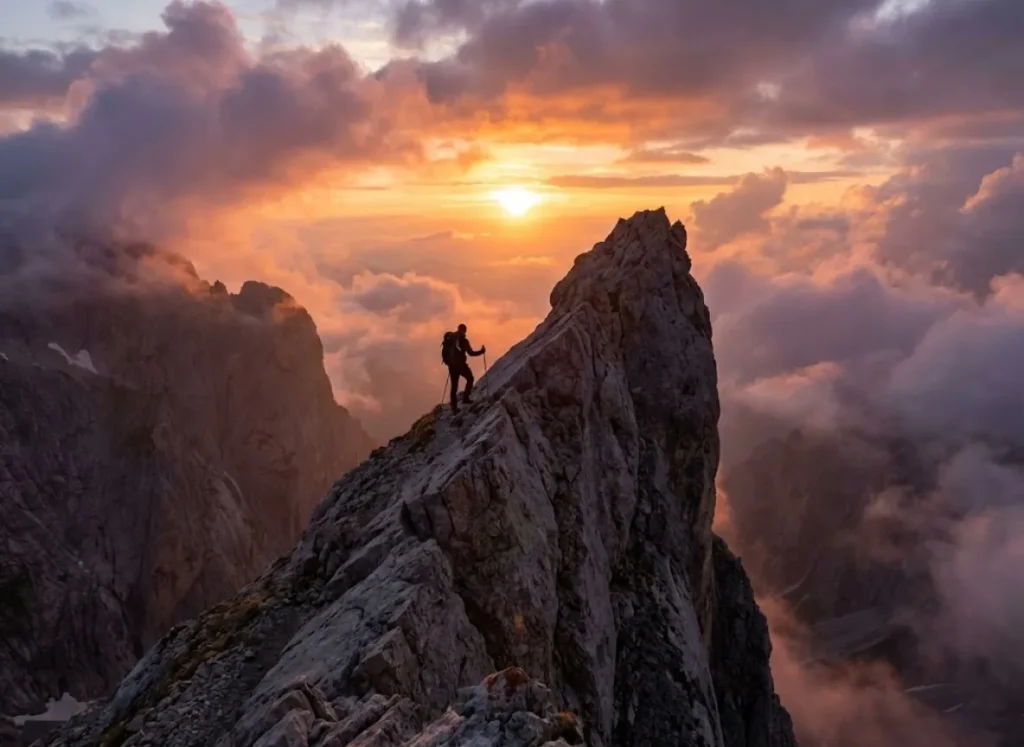
To truly grasp these risks, we must move from abstract decimal system information to concrete examples on the most famous mountains in North America.
How does the “Exposure Blind Spot” affect ratings like Angels Landing vs. Half Dome?
Angels Landing (Zion): Rated Class 3 due to chains, but features sheer vertical drop-offs of 1,000+ feet. The risk is vertigo and crowding, not difficult movement.
Half Dome Cables (Yosemite): Rated Class 3 with cables. Without cables, the 45-degree polished granite slab would be a slippery Class 5 death trap. The National Park Service: Half Dome Cables Safety page warns that rain makes this route deadly even with the cables.
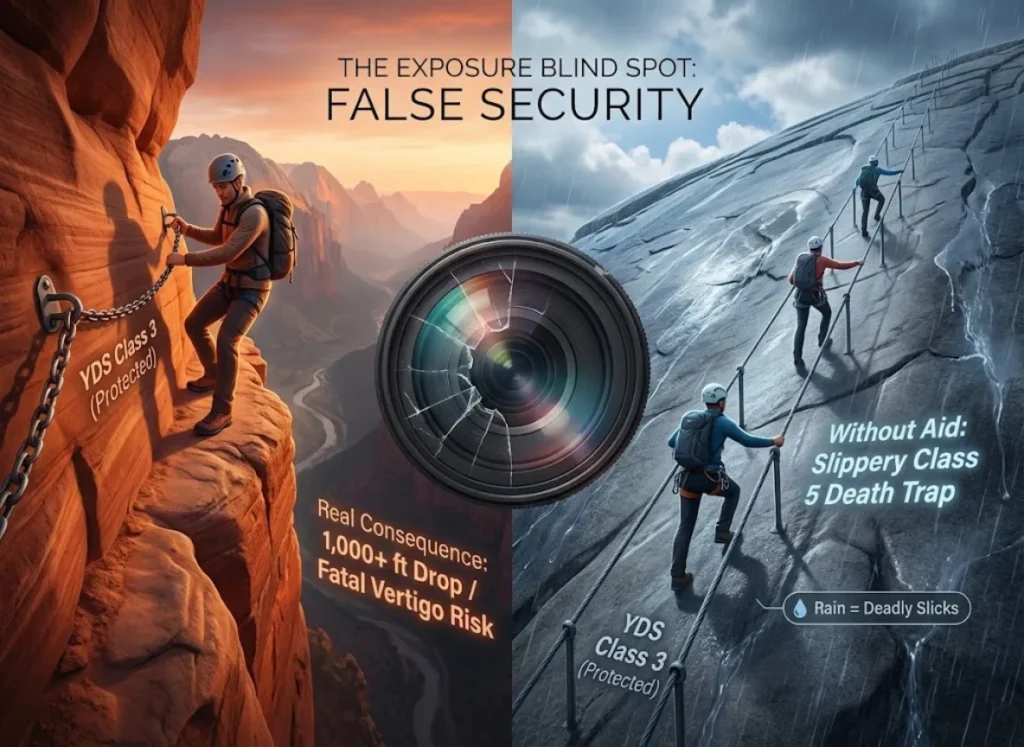
These routes represent “Protected Scrambling.” The presence of handrails creates a false sense of security that does not exist on a backcountry peak. When ranking America’s bucket list hikes by skill, it is crucial to distinguish between routes with safety nets and those without.
Why are Colorado 14ers like Capitol Peak and Longs Peak deceptively dangerous?
Longs Peak (Keyhole Route – Class 3): The “Homestretch” consists of smooth granite slabs. The danger is not just the steepness but the extreme physical fatigue hikers feel after 12+ miles, leading to sloppy footwork.
Capitol Peak (Knife Edge – Class 4): Famous for its 100-foot razor ridge. The exposure is absolute. However, the real killer is the “Death Gully” phenomenon: hikers trying to avoid the exposed ridge descend into loose talus gullies where rockfall is inevitable.
The Colorado Department of Public Safety: Backcountry Safety Info highlights how environmental factors skew ratings. A Class 3 slab on Longs Peak becomes a Class 5 slide-for-life if covered in verglas. When selecting good hikes in Colorado, ensure your resume matches the route’s demands, not just your fitness level. Familiarize yourself with local challenges like Kelso Ridge on Torreys Peak or the Crestone Needle, which defy standard definitions.
What skills and gear bridge the gap between hiking and scrambling?
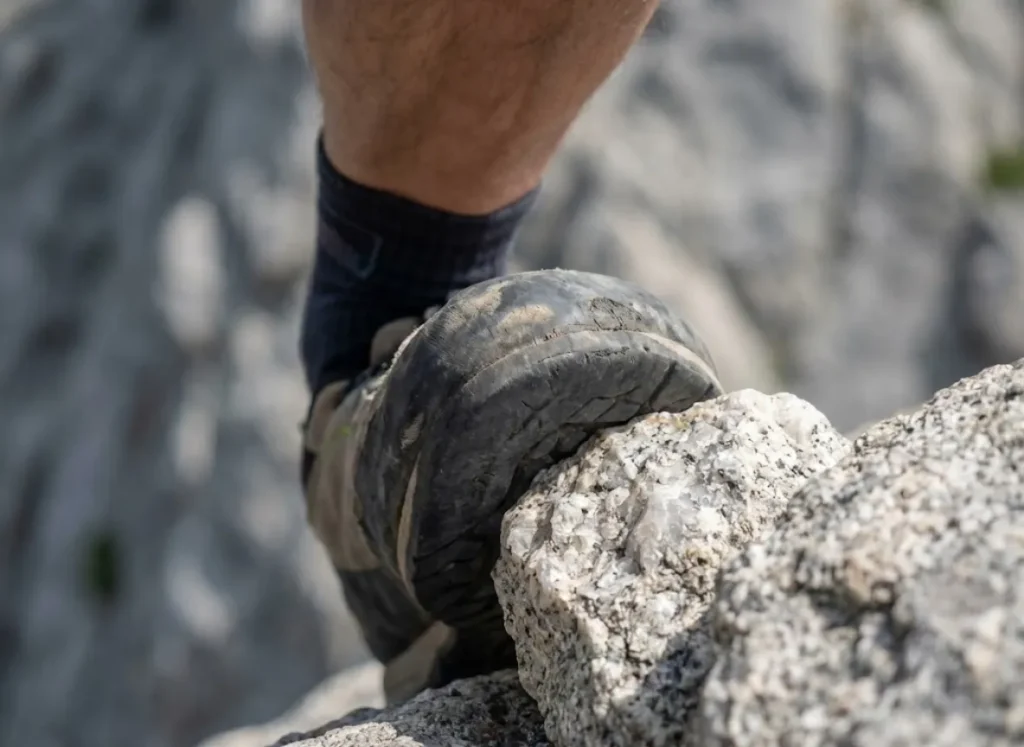
Surviving these peaks requires more than just grit; it requires a fundamental shift in the equipment on your feet and the way you move your body.
Why do hiking boots fail in Class 3 and 4 terrain?
Traditional hiking boots feature deep lugs designed for mechanical traction in mud and dirt. On steep rock, these lugs can roll or shear, reducing the contact patch to near zero.
The rubber on hiking boots is often carbon-doped for durability. This makes it hard, meaning it provides low friction on granite slabs. The solution is “Approach Shoes.” These feature “sticky rubber” and a flat “climbing zone” under the toe, borrowing technology from dedicated climbing shoes. MIT School of Engineering: Friction Explanation details how softer compounds increase the coefficient of friction, which is the physics keeping you on the wall.
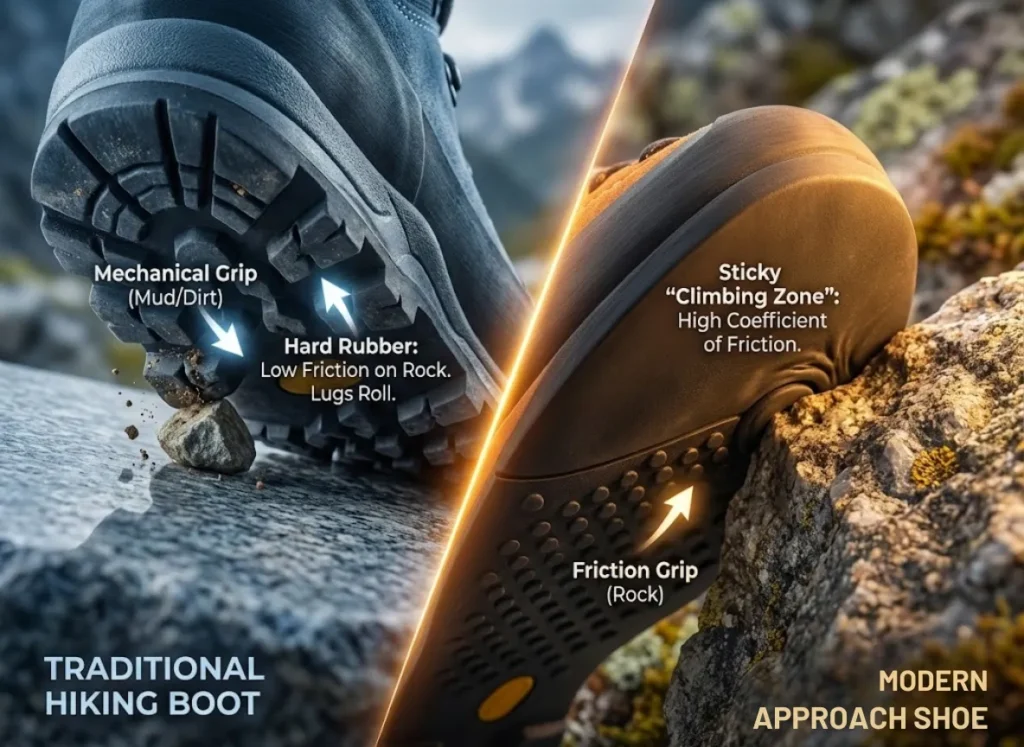
If you are deciding between approach shoes or hiking shoes, ask yourself: does the route require me to edge on coin-sized rocks? If yes, leave the boots at home.
How must a hiker’s movement change when the trail ends?
Counter-Instinct: The natural fear response is to hug the rock. This pushes your center of gravity out, reducing the grip on your feet. You must stand up straight to apply pressure to your soles.
Mantle: This is the essential move for ledges. Press down with your palm (tricep press) to lift your body, then high-step your foot onto the same hold.
Stemming: Used in chimneys or corners. Push outward with hands and feet against opposing walls. This relies on skeletal compression rather than muscle strength. Dartmouth Outing Club: Climbing Skills emphasizes these techniques as foundational for moving efficiently.
Pro-Tip: “Nose over Toes.” Keep your face away from the rock. This allows you to look down and see your foot placements. If your nose is touching the rock, you are climbing blind.
Implementing a complete hiking training system should include mobility work for high-stepping and core strength for maintaining balance in exposed positions.
Final Thoughts on Risk
The Yosemite Decimal System is a useful tool, but for the hiker, it is an incomplete one. The decimal digits on the map do not account for loose rock, sudden storms, or your personal fear response to exposure.
Class 3 implies injury risk. Class 4 implies fatality risk without ropes. The “Grey Zone” between them is where the safety net of the trail disappears. Benchmark peaks like Capitol Peak and Longs Peak demand specific gear and movement skills that standard hiking simply does not develop.
Risk is dynamic. By understanding the mechanics behind the ratings—whether it’s the Sierra Club standard or a hiker’s risk matrix—you can make informed decisions rather than relying on luck.
Ready to test your skills? Start by exploring our guide to “Conditioning for the Alpine” or share your experience with your first Class 3 scramble in the comments below.
FAQ – Frequently Asked Questions
What is the difference between Class 3 and Class 4 scrambling?
Class 3 requires hands for balance and climbing, where a fall would likely cause broken bones. Class 4 involves steeper, more vertical rock where a fall would likely be fatal, and ropes are often recommended.
Do I need a rope for Class 4 terrain?
While not strictly mandatory for upward movement (if soloing), a rope is highly recommended for safety. However, carrying a rope requires the knowledge to use it (knots, anchors, belaying), or it becomes a liability.
Is Class 5.9 hard compared to hiking?
Yes, extremely. Even Class 5.0 represents technical rock climbing requiring a harness and protection. Class 5.9 was once considered the hardest grade in the world (before the decimal extension expanded the scale). It is impossible for a hiker without specific rock climbing skills.
What shoes should I wear for Class 3 hiking?
Leave the bulky hiking boots at home. Approach Shoes with sticky rubber (like Vibram Megagrip) are the industry standard for Class 3 and 4, offering the friction of a climbing shoe with the comfort of a hiker.
Risk Disclaimer: Hiking, trekking, backpacking, and all related outdoor activities involve inherent
risks which may result in serious injury, illness, or death. The information provided on The Hiking Tribe is for
educational and informational purposes only. While we strive for accuracy, information on trails, gear, techniques,
and safety is not a substitute for your own best judgment and thorough preparation. Trail conditions, weather, and
other environmental factors change rapidly and may differ from what is described on this site. Always check with
official sources like park services for the most current alerts and conditions. Never undertake a hike beyond your
abilities and always be prepared for the unexpected. By using this website, you agree that you are solely
responsible for your own safety. Any reliance you place on our content is strictly at your own risk, and you assume
all liability for your actions and decisions in the outdoors. The Hiking Tribe and its authors will not be held
liable for any injury, damage, or loss sustained in connection with the use of the information herein.
Affiliate Disclosure: We are a participant in the Amazon Services LLC Associates Program, an
affiliate advertising program designed to provide a means for us to earn advertising fees by advertising and linking
to Amazon.com. As an Amazon Associate, we earn from qualifying purchases. We are also an official affiliate partner
of Black Diamond Equipment via the AvantLink network. If you click on a Black Diamond affiliate link and make a
purchase, we may earn a commission at no additional cost to you. We also participate in other affiliate programs and
may receive a commission on products purchased through our links. Additional terms are found in the terms of
service.